Skip to content
© Hotel Muchele

Northern Italy's Young chef scene

Gourmet
Italy
Chef Alps

It took years for the culinary riches of the Alps to be tapped into by top restaurants. Now, a new generation is on the way in South Tyrol, which is also accentuating a new culinary aproach. Reason enough for a Falstaff Travel foray to the region's young chefs.

© Hotel Muchele

The exceptionally high standard of South Tyrolean cuisine is nothing new. Traditional inns and numerous hotels in the Italian Alps have been serving outstanding dishes for decades. Pioneers such as Herbert Hintner ("Zur Rose", Eppan), Karl Baumgartner ("Schöneck", Pfalzen) or Anna Matscher ("Zum Löwen", Tisens) were largely responsible for this development. Above all, they popularized high-end, home-style cooking long before the word "bistronomy" existed. "Kloazn-Ravioli with Graukäse" – a Hintner dish – is emblematic of this modernized traditional mountain cuisine.

pic provided

Norbert Niederkofler then cemented their international fame: "Cook the mountain" became his motto, which was heard around the world. The three-star chef is still proud to have run "the only Italian restaurant without olive oil" in his "Rosa Alpina" in San Cassiano. But Niederkofler also says: "My career as a chef ended with the Rosa Alpina." In his new restaurant "Atelier Moessmer", 32-year-old Mauro Siega is the head chef. The focus to regional ingredients has remained – even their "Linzer Torte" is seasoned with a rare type of local basil instead of imported cinnamon. But once again, the 63-year-old star chef has shown a flair for trends: In South Tyrol, a new generation of chefs is stirring it up – now it's their turn!

Three stages of cooking

© Hannes Niederkofler

However, there is no common agenda, no manifesto for the new South Tyrolean cuisine: chestnut miso, as served by Christoph Huber ("Zur Blauen Traube", Algund), differs from the Copenhagen "Noma" aesthetic that Levin Grüten prefers at "AO by Haller" (Brixen). Nevertheless, there are similarities, which Thomas Ortler of "Flurin" in Glurns summarizes in a chart that he puckishly calls "Tom's Theorem". According to this, "South Tyrolean original cuisine" was everything that their grandmothers cooked. The Mediterranean influence – long seen as political in the German-speaking community – was then integrated by the mothers' generation. "Cooking traditions are changeable," says the "Flurin" chef, who is now proclaiming the age of "South Tyrolean world cuisine".

pic provided

The climatic conditions have also contributed to the transition. Ortler sources the pak choi for his restaurant directly from Glurns. "We are very lucky that our winters in Girlan are no longer as cold as they used to be," Manuel Ebner confirms. The chef at the "Ansitz Rungghof" can now offer winter varieties such as cabbage or root vegetables from their own garden.

Necessity is the mother of minimalism

pic provided

However, the "local exotics" food trend is just a new variation on the greater whole of South Tyrolean cuisine. The new culinary philosophy also includes pride in basic produce gathered directly from the mountains. This is perhaps where the change in culinary tradition is most evident: Tt is precisely the few foods that were available in the harsh high-altitude world of the Dolomites that have made the transition from pauper's meal to delicacies served in the finest establishments. This is because those few regional resources have retained their identity and are not interchangeable. With this in mind, South Tyrolean specialties are being rediscovered and repurposed for the gourmet world.

© Tom Ortler

Seven years ago, for instance, Claudia and Roland Eder resumed production of the traditional Graukäse (gray cheese) at the "Moarhof". Ten Simmental cattle are enough for the "Moarhof" operators to make a living. The restaurant trade appreciates the cheese made from skimmed milk – with a fat content of just two percent, what was once the meagre remainder left over after the farmers sold their butter is now in high demand. "We were exotic in our own country," says herbalist Anneres Ebenkofler a few houses away in Ahornach, recalling the beginnings of this movement.

Creative conservation

pic provided

The owner of "Hofel Moosmair" – a farm hotel that specializes in cooking with its own produce – was still arguing with her chef in 2006, "who much preferred lobster and langoustine". A few years ago, however, she found a kindred spirit in chef Dominik Leiter. Ten times a year, he adapts the entire menu to the seasons. "From May onwards, I start planning for the winter." Even the dishes change their names over the year: The beef cooked in meadow herbs is called "Beef on a summer retreat", while the fall menu lists it as "Beef in a hay bath".

Fascinating fermentation

© Hannes Niederkofler

Mattia Baroni chose a different way to offer Alpine delights all year round. Having made a name for himself with the TV show "La Prova del Cuoco" on Rai 1, the chef of the hotel "Bad Schörgau" is now considered an authority on koji fermentation. The Japanese fungus (Aspergillus oryzae), which is used in sake and soy sauce production, intensifies practically every flavor, according to Baroni. He dries trout from the Sarntal valley and makes it succulent again with a fish ferment that has matured for 18 months. Baroni, who studied engineering, uses chestnuts, garlic and even leftover oranges from breakfast in this way: "With artichokes, 70 percent of the vegetable such as leaves and stems are thrown away – but not here."

pic provided

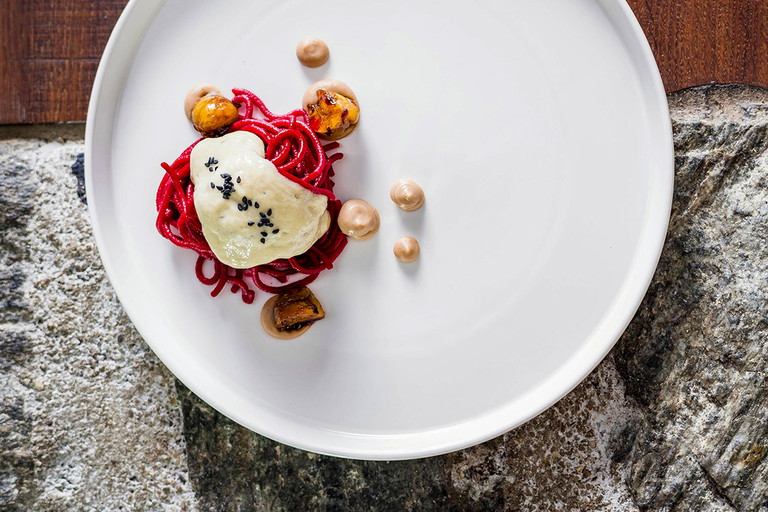
This sustainable cuisine can be experienced as part of "La FuGa". This is the name given in Bad Schörgau to their special creative culinary journey, which is limited to eight participants. And the journey is quite literal: Baroni serves two courses directly in the kitchen, while hotelier Gregor Wenter serves natural wines specially bottled for the hotel. The signature dish is the visually inconspicuous "spaghetti al burro", whose umami flavor rivals that of any pasta carbonara with guanciale – except that here, it comes from fermented whey.

© Hannes Niederkofler

This by-product, which has so far received little attention and is produced by the hectoliter in the cheese dairies of South Tyrol, has become a minor star among young chefs. Alessandro Bellingeri in St. Michael/Eppan also serves his risotto with whey and fir tree tops as local aromatics. This dish at "Acquarol" is a symbol of this new type of fusion cuisine that is based in Italy but is open to the world. It can happen that the oysters at Luis Haller's "Schlosswirt Forst" actually consist of vegetables – which come from the regional permacultures of the Köstbamer Gut. In this sense, South Tyrol's young scene is deeply rooted. And yet it radiates further than ever before among gourmets!

The Falstaff Travel Editors
Author
Find out more
1 / 12