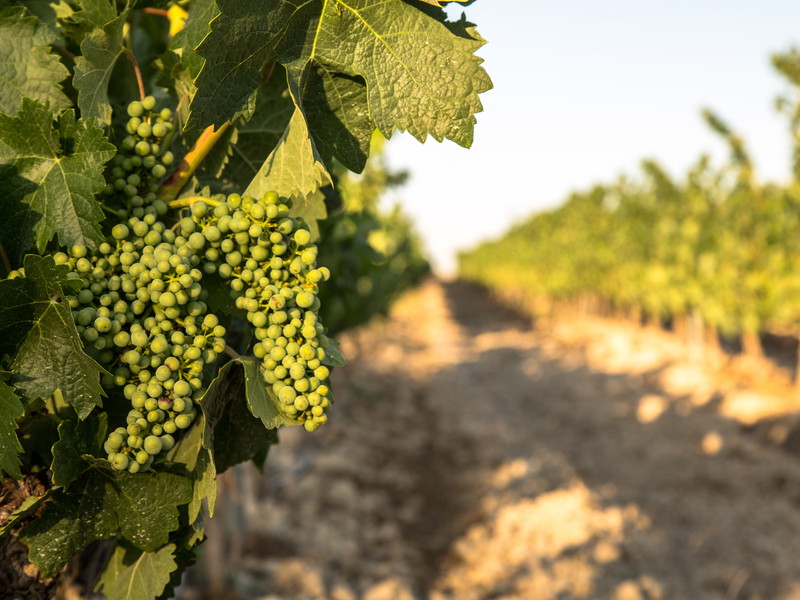
Although the name suggests it, the origin of Morio nutmeg is still not entirely clear today. What is certain is that it is a crossing that was carried out by Peter Morio in 1928. Silvaner and Pinot Blanc were initially assumed to be the crossing partners, but Pinot Blanc was later replaced by Muscatà Petit Grains, which seems more realistic in view of the subtle muscat aroma. Neither variant has been verified to date. The Morio nutmeg ripens late rather than early and unfortunately shows a very high susceptibility to downy mildew, but also to a limited extent to powdery mildew and sour rot. It also tends to produce quite high yields with a rather low must weight. If it does not fully ripen, it tends to have a greenish-grassy character. It was approved as a grape variety for commercial cultivation in 1956 and initially found its way into the cuvée of the infamous “Liebfrauenmilch”. The total vineyard area in Germany today amounts to around 3,000 hectares, the largest proportions are in Rheinhessen and the Palatinate. Some winemakers today produce very high-quality, pure Morio Muscat, while others produce rather simple wines in the semi-dry and sweet range. To an extremely small extent, vineyards can also be found in Austria, South Africa and Japan.
This grape variety is also known by the name of:
Morio Muscat, Geilweilerhof I- 28- 30, Morio Muskat