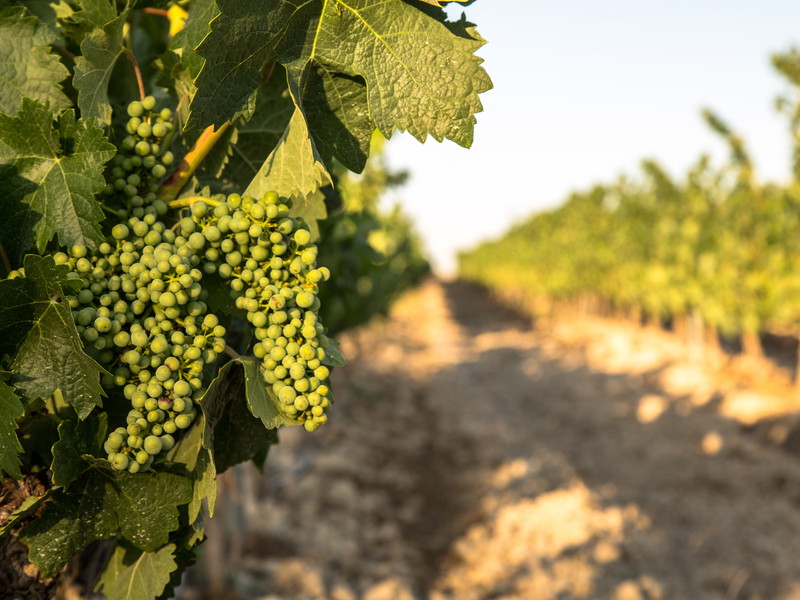
For a long time, the Neuburger was thought to be a cross between Pinot Blanc and Silvaner, without being able to identify or even suspect a creator. You couldn't either, because today we know, thanks to the most modern analysis methods, that the Neuburger is a natural cross between Roter Veltliner and Silvaner, but it can no longer be dated. What is certain, however, is that Neuburger's first wine was produced in 1872 in the Wachau, where a few vineyards are now planted with it. Today, its main distribution of the total of around 650 hectares in Austria is in the thermal region, in Lower Austria and partly also in Burgenland. It ripens over a medium period of time and the closely spaced berries are particularly susceptible to sour rot and downy mildew. Neuburger's wines are a bit out of the ordinary, on the one hand they are full-bodied, full-bodied and mild, but on the other hand they seem almost Burgundian with their nutty-spicy character. Outside Austria, the Neuburger can only be found in neighboring countries to the east, such as Morava (Moravia) in the Czech Republic with around 360 hectares or Slovakia; there are still small areas in Romania.
This grape variety is also known by the name of:
Brugler Burgrebe, Feher Neuburgi, Feher, Brubler, Neuburg, Neuburger Alb, Neuburger Blanc, Neuburger Bianco, Neuburger Weisser, Neuburske, Neue Rebe, Ujvari Neiburger