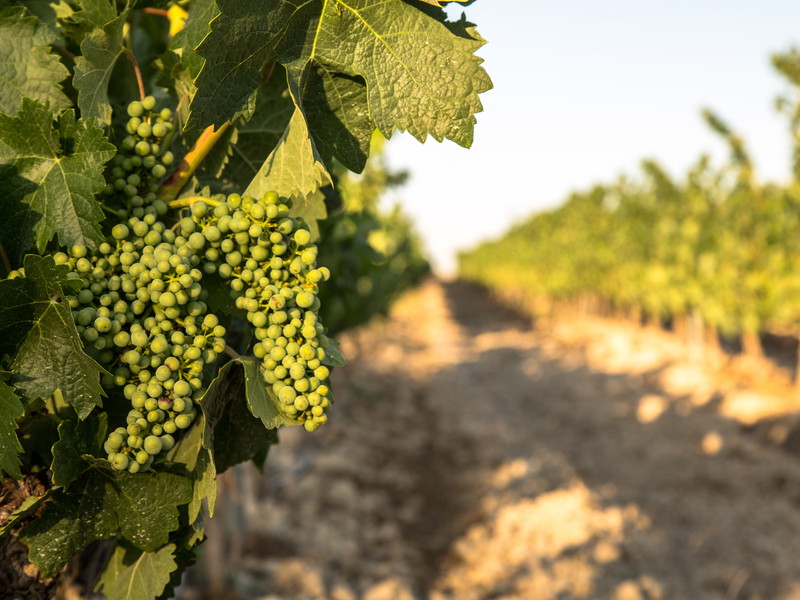
The white wine variety Jacquère is one of the long-established grape varieties of the Savoy region and was first mentioned in 1861. However, it may have been in the region for many centuries, as it is said to have been named after the person who introduced it in the 13th century. But that is not guaranteed. What is certain, however, is that the Jacquère is a descendant of the Gouais Blanc variety, which - in contrast to today - was once widespread in Europe. The productive and high-yielding grape variety sprouts early and ripens after a medium to long ripening period. It requires pruning to be short and concise. It shows little susceptibility to both variants of powdery mildew, but is even more susceptible to putrefactive diseases such as black rot or sour rot. The homeland of Jacquère is and remains Savoy, where the variety is approved for wine production. It produces the best results as Vin de Savoie or as Vin de Bugey. The wines are fruity and intended for early consumption. They are mostly dry-grown. Jacquère can be found on a good 1,000 hectares of vineyards in France, almost exclusively limited to the Savoy region. Very small plantings can also be found in Portugal.
This grape variety is also known by the name of:
Altesse de Saint-Chef, Coufe Chien, Cherché, Blanc des Ecoutoux, Buisserate, Cugnète, Cugnette, Cugniette, Molette de Montmelian, Molette, Jacquère blanche, Plant des Abymes, Jacquerre, Jacquière, Roussette de Montmelian, Martin cot blanc, Plant de Myans, Robinet, Redin, Rossette, Rossettin