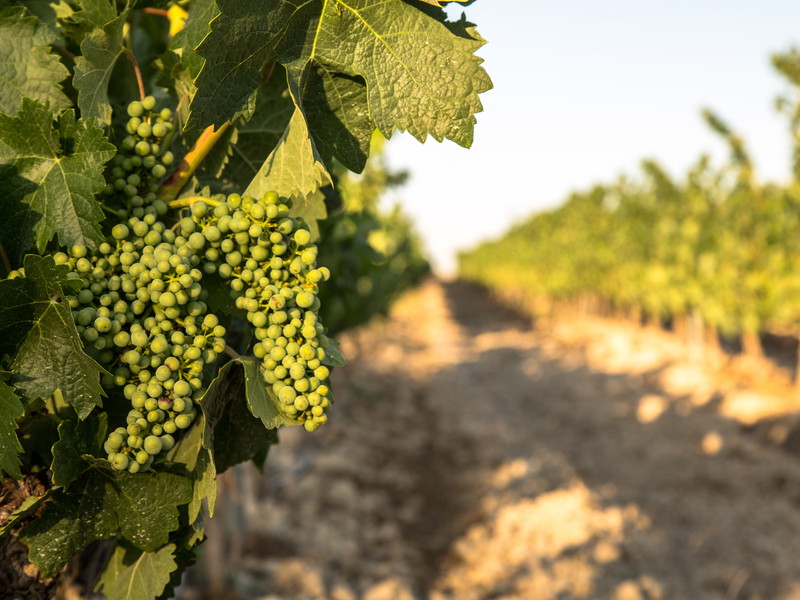
Vinhão is a long-established red wine variety in Portugal, whose origins most likely lie in the Minho region or in the Vinho Verde growing region. Around 1790 it also came to the Douro region, which borders Minho in the southeast, where it is called Sousão. While the Vinhão in the Minho primarily produces red Vinho Verde, in the Douro it gives port wines a deep, dark color due to its extreme color depth if they turn out to be too light. The grapes are medium-sized, the berries are extremely thick-skinned and therefore very resistant to rot and fungal diseases. The Vinhão sprouts late and also ripens late. In Portugal, the Vinhão produces the darkest wines ever, the play of colors is so intense. So intense that it even gives the impression that the flesh is red. In Vinho Verde, the Vinhão with its accentuated acidity and intense color serves as the basis for the high-quality red Vinho Verde. After white Vinho Verde was preferred in the second half of the last century, red Vinho Verde is now experiencing a small renaissance again. However, it is usually blended for the red Vinho Verde and not made into a pure variety. In the Douro, the Vinhão is usually mixed in the vineyard and is still used to intensify the color of the port wine. However, a few port wine producers give it a more important role in the cuvée. Almost 600 hectares are also produced in Spain, where it is also called Sousão, especially in Galicia, in Rías Baixas, Ribeiro and Valdeorras. Winemakers in California, Australia and South Africa are also experimenting with this variety on a few hectares.
This grape variety is also known by the name of:
Espadeiro Preto, Espadeiro Basto, Espadeiro Do Basto, Espadeiro Da Tinta, Espadeiro De Basto, Negron, Pazao, Pe De Perdiz, Negrao, Negrao Pe De Perdiz, Tinta Femea, Tinto Antigo, Pinta Femea, Vinon, Tinta De Parada, Sousao, Retinto, Sesao, Souzao, Sousao De Correr, Souzao Forte, Souzon Retinto, Sousen, Souson, Sousao Do Douro, Souson Retinto, Tinta De Luzin, Tinto De Parada, Sousao Forte, Tinto Da Parada, Tinta Antiga, Tinto Nacional