Skip to content
© Shutterstock

Prinsesstårta – Swedish princess cake

Recipe
Cake
Sweden
Nordics

The traditional Prinsesstårta (princess cake) is one of the most popular Swedish pastries and is a must on every coffee table.

Emilia Rieth
The Swedish princess cake has its roots in Jenny Åkerström's Prinsessornas kokbok ("The Princesses' Cookbook"), which the author dedicated to Sweden's princesses Margaretha, Märtha and Astrid back in 1929. Originally, the cake was called Grön Tårta ("green cake") because of its delicate green maripan crust. Because the three princesses liked the cake so much, it was later dubbed Prinsestårta.

Swedish sensation

With its layers of fluffy sponge cake, vanilla, raspberry jam and cream, this popular cake is often used for birthdays and holidays. In 2004, the Swedish Bakers' and Confectioners' Association even launched the annual Prinsesstårtans vecka, where part of the proceeds from the sale of princess cakes are donated to charity in the last week of September.

Royal coffee party at home

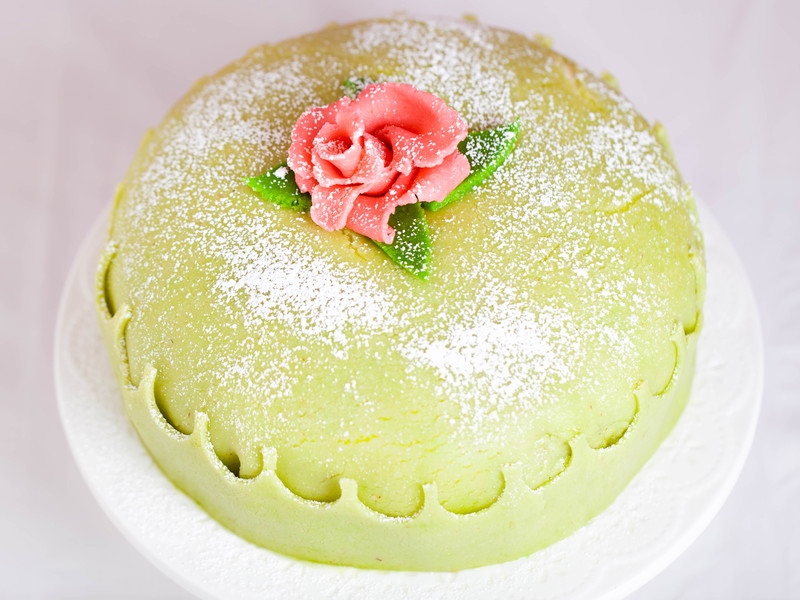
Whether it's the classic green or variations covered in pink or yellow marzipan (called opera cake and prince cake, respectively) and decorated with a small marzipan rose, one thing is certain: This Swedish cake is not only a looker, but also a real treat thanks to its surprising lightness. What's more, you need relatively few ingredients for a Prinsesstårta and it's easier to make at home than you might think. Traditionally, it is filled with raspberry jam, but strawberry, blueberry or blackberry also harmonize wonderfully with the delicate vanilla cream. The main trick is pouring the marzipan crust over the cake without tearing it, but we have a few tips for that too.

For the spongecake base

Ingredients
3 Eggs, size L (room temperature)
100 g Sugar
100 g Flour
1/2 teaspoon(s) Baking powder
1 pinch Salt

For the vanilla cream

Ingredients
380 ml Milk
60 g Sugar
1 teaspoon(s) Vanilla extract
3 Egg yolks
3 tablespoon(s) Corn starch
25 g Butter
1 pinch Salt

For layering

Ingredients
450 ml Cream
30 g Raspberry jam (or strawberry, blueberry or blackberry jam)
200 g Raw marzipan paste
some Food coloring in green and red
some Powdered sugar
  • To make the spongecake base, first preheat the oven to 175 °C and grease a ⌀20 cm springform pan with butter and dust with a little flour.
  • In a large bowl, beat the eggs and sugar well with a hand mixer for about 8 minutes until a light yellow mixture forms.
  • Sift in the flour, baking powder and salt and fold in with a spatula until you have a smooth dough.
  • Pour the batter into the springform pan and bake for approx. 20-25 minutes on the lower shelf until the surface is golden brown. Leave the sponge cake to cool in the pan, then carefully remove  and cut into three layers with a sharp knife.
  • For the vanilla cream, heat the milk, sugar and vanilla extract in a small pan over medium heat for about 1-2 minutes (do not boil!).
  • Mix the egg yolks and cornstarch in a bowl. Gradually add the warm milk, stirring constantly. Pour the entire mixture back into the pan and simmer over medium heat for approx. 8 minutes until it thickens. Stir constantly so the cream does not burn!
  • Remove the cream from the heat and stir in the butter and salt.
  • Transfer the vanilla cream to a bowl and cover with cling film. Place directly on the surface to prevent a skin from forming. Leave the cream to cool completely.
  • To assemble your cake, first whip the cream until stiff. Spread the jam on the first layer of sponge cake on a cake plate, leaving a 1.5 cm gap to the edge.
  • Place the second sponge cake on top and spread the vanilla cream to a thickness of approx. 1.5 cm. Again, keep 1.5 cm from the edge. (The vanilla cream does not have to be used completely).
  • Now add the third sponge cake on top and spread the whipped cream on top to form a dome measuring approx. 7 cm in the middle.
  • To decorate, first dye 180g of the marzipan with green food coloring. Dust the work surface with powdered sugar and then roll out the marzipan into a thin ⌀40cm circle. Make sure that the marzipan is not too thin – there should be no cracks. Keep lifting the marzipan slightly and dust with more powdered sugar to prevent it from sticking to the tabletop.
  • Dust the surface of the marzipan circle with powdered sugar and roll it up on a rolling pin. Now carefully drape the marzipan over the cake. Work from top to bottom and smooth out the marzipan so that there are no creases. Use a sharp knife to cut off the remaining marzipan at the bottom of the cake. Using your hands or a spatula, spread the marzipan to create a clear dome. Finally, remove the powdered sugar residue with a pastry brush.
  • For the marzipan rose, dye the remaining 20g of marzipan with red food coloring. Shape the marzipan into a small 0.5 cm thick sausage, make vertical parallel indentations with your index finger and then roll up the resulting ribbon to form a rose. Press the ends together slightly at the bottom.
  • Make a small indentation in the center of the cake and fix the marzipan rose in place. Dust the cake with powdered sugar before serving.

Emilia Rieth
Author
Find out more
1 / 12