The gentle revolution in Alsace
Wines from Alsace are often considered antiquated. Wrongly. Today, a dynamic generation of winemakers produces grandiose white wines that have long been among the world's best, but are still underestimated.
It is wineries like Trimbach, Weinbach, Hugel or Zind Humbrecht that have made Alsace famous as a wine region. A wine region that at first glance stands for tradition, one thinks less of innovations and modern viticulture. However, this image is false, because today Alsace, of all places, has an above-average density of young and innovative winemakers. They are winemakers who often explore the potential of their terroirs using alternative methods.
Interestingly, many of the traditional wineries have also embarked on this new path of organic or biodynamic viticulture. The "AB" seal commonly used in France - it stands for "agriculture biologique" - is increasingly found on the back label. Alsace today presents itself immensely complex, in addition to the traditional styles you can find a wide range up to the Orange Wine and the Vins Naturels.
Organic or biodynamic farms now abound in Alsace. More than 250 organic farms already cultivate 13 percent of the appellation's vineyards (in 2011, 2062 hectares were organic or in conversion, and 112,600 hectoliters were produced). And although organic production in vineyards and cellars is clearly regulated, the Alsatians have imposed rules on themselves in a special charter called "Vinabio" that are adapted to their region and go beyond EU wine law.
On May 1 of each year, wine lovers have the opportunity to taste a large number of organic wines; this year, the traditional "Rendezvous" took place for the tenth time at Château de Kientzheim near Kayserberg. The 40 or so "Vinabio" winemakers include such renowned wineries as Zind Humbrecht, Marcel Deiss and Clément Klur. Some producers of remarkable Vins Naturels are also at work, to mention Patrick Meyer of Domaine Julien Meyer in Nothalten with his Riesling Muenchberg Grand Cru, Domaine Rietsch, Audrey and Christian Binner, Vincent Stoeffler or Jean-Pierre and Chantal Frick.
There are many authors who place the beginnings of viticulture in the area of today's Alsace in the time of the Romans, the first written evidence of the existence of vineyards between Thann and Marlenheim dates back to the 10th century. While in those early days wine was grown in about 160 villages, around 1400 there were already 430 villages. In the 1600s, Alsatian wines gained enormous importance and the region had become one of the most important wine-growing regions in Europe. However, the Thirty Years' War, which ended in 1648, left a trail of devastation: villages lay in ruins, vineyards were devastated. Only slowly, viticulture was resumed, the vines are increasingly planted on plains and less on slopes.
In 1871 Alsace was annexed by Germany, and the harvests were subsequently often used for blending with German assemblage wines. From the appearance of phylloxera and vine diseases, Alsace wine culture is hit hard. In 1918, Alsace is again French, and in 1925, the decision is made to take on the production of quality wine. The majority of the vineyards on the plain are abandoned, and the advantages of the slopes are being reconsidered. In 1962, Alsace became part of the AOC wine family, and in 1975, the Schlossberg site was recognized as the first Grand Cru site - followed by another 50 top terroirs to date.
From 1972, Alsatian wines could only be bottled directly in the territory. In 1976, the Crémant d'Alsace AOC is born, which has had a very positive evolution. In 2011, the recognition of the single vineyards "lieux-dits" and the local appellations "communales" took place. Protected by the forest-covered ridge of the Vosges Mountains, precipitation is kept within limits, winters are usually harsh, and spring tends to be mild despite the area being northern for viticulture. Summers are usually dry and warm, there lurk storms with hail. At the beginning of August this year, vineyards near Colmar and Turckheim were hit by ping-pong ball-sized hailstones, and in parts of southern Alsace the losses amount to up to 60 percent of the harvest.
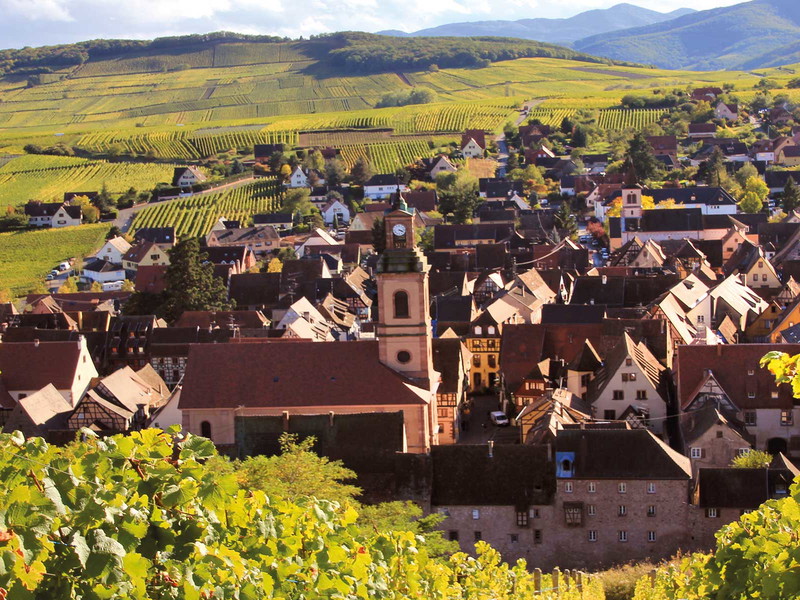
The vineyards of Alsace stretch in a line along the lower part of the south-facing slopes of the Vosges Mountains, which slope towards the Rhine River. They extend over the departments of Bas-Rhin and Haut-Rhin, where, thanks to the climatic conditions, the better wines and also the bulk of the important farms are found. The higher, often steep vineyards have a thin topsoil layer lying on sandstone, weathered gneiss, granite or slate, including sites of volcanic origin.
Further down, the primeval Rhine has carved rather gentle gradients into the slopes, here layers of limestone, clay and marl, and again sandstone lie beneath deeper bedding. This red Vosges sandstone, known as "Grès des Vosges" , was already a valued building material in the Middle Ages and characterizes the image of the villages and towns of the region. At lower altitudes and on the plain, the soils of marl, clay and alluvial sediments grow broad-shouldered, rather massive wines, while the calcareous soils yield finesse-rich products. The different slate sites suit the Riesling, they give it the special petrol flinty note. The best vines grow on south-facing steep slopes, where they get the most sun.
For Alsatian winemakers, due to the cooler climate, slow ripening cycles of the grapes are the rule. The temperature differences between day and night lead to the development of complex aromas, freshness and fruit are preserved and you harvest structured wines with ripe acidity. Because soil conditions can vary widely even within winegrowing communities, many plots are relatively small.
In order to be able to respond optimally to the conditions of the terroir, one relies on seven main varieties. The six main ones are Riesling, Sylvaner, Pinot Blanc, Pinot Gris, Muscat d'Alsace (often a mix of Muscat Ottonel and Muscat Blanc) and Gewürztraminer, with Pinot Noir added. These are joined by small quantities of specialties such as Chardonnay, Chasselas and Klevener de Heiligenstein, a reddish Savagnin mutation. Until 2007, Pinot Gris was also called Tokay d'Alsace. AOC wines, which usually bear the name of the grape variety and come from demarcated plots in the traditional core growing areas, now account for around three quarters of production.
If the wines meet higher requirements, the indication of the municipality can be added as a supplement. These are the AOC communal designations that eleven communes are entitled to use: Blienschwiller, Côtes de Barr, Côte de Rouffach, Klevener de Heiligenstein, Ottrott, Rodern, Saint-Hippolyte, Scherwiller, Vallée Noble, Vla Saint-Grégoire and Wolxheim. The requirements for single vineyard sites, known as "lieux-dits" in Alsace, are even more far-reaching. The requirements for grape variety, planting density, pruning, grapevine training, ripeness of the berries and yield are stricter than for the AOC Communales. The highest level of designations of origin is occupied by the 51 Grands Crus.
The AOC Alsace Grands Crus has been in existence since 1975 and defines these delimited "lieux-dits". In 2011, these 51 individual vineyards were also recognized as independent appellations. The Grands Crus occupy about eight percent of the vineyard area and produce about four percent of Alsace's wine yield. Only four grape varieties are allowed in these areas: Riesling, Pinot Gris, Gewurztraminer and Muscat. There are three exceptions: Altenberg de Bergheim, Zotzenberg and Kaefferkopf in Ammerschwihr, where the varietal composition is somewhat different. In suitable years, when Botrytis cinerea develops in the fall, the assortment of many winemakers is joined by the Vendanges Tardives (Late Harvests) and sometimes the rare Trockenbeerenauslesen (Sélections de Grains Nobles), which are prized by sweet wine connoisseurs.
The AOC Crémant d'Alsace has been in existence since 1976, and sparkling wines produced according to the traditional Champagne method already account for a quarter of production. For this, the Burgundy varieties, Riesling and Auxerrois are allowed. Crémant d'Alsace is particularly attractive because of the good price-quality ratio. The number of producers is growing and already exceeds 500. Pinot Noir is the only red wine variety permitted for AOC wines, and here the range extends from rosé to light, fruit-driven wines to storable styles.
Alsace in facts
- The area under cultivation is about 15,600 hectares.
- 90 percent of Alsace and Alsace Grand Cru wines are white. Alsace bottles 18 percent of the AOC wine produced in France.
- In 119 municipalities 4600 winegrowers are engaged in viticulture.
- More than 80 percent of the crop is bottled by about 175 larger companies, the majority of which are family businesses.
- The average annual production of AOC wines is 140 million bottles.These have been bottled exclusively in the region since 1972.
- Around 75 percent of the wines are consumed in France, with annual net sales of around 500 million euros.
- Exports are made to 130 countries around the world; Europe is the largest importer with 76 percent.
- The exclusive, legally protected wine bottle is called "flûte".
From Falstaff Magazine No. 07/2013