Skip to content

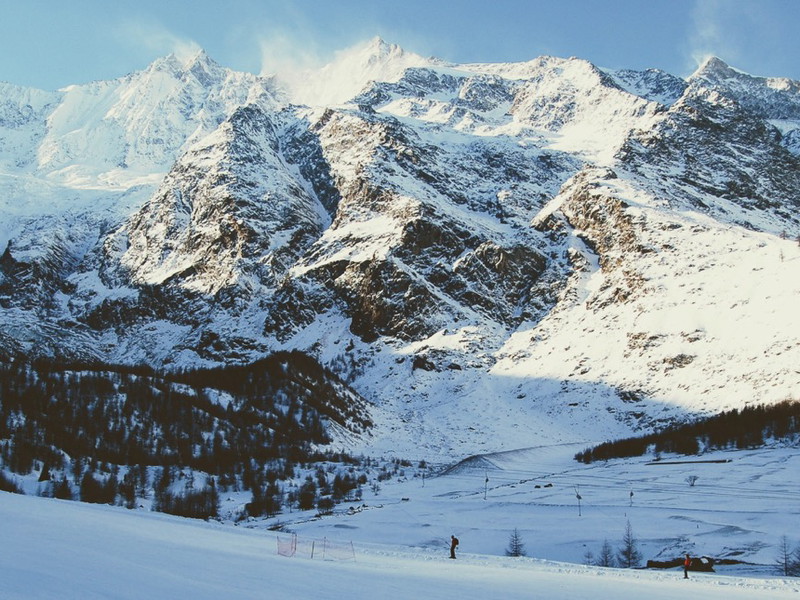
The Saas Valley offers a unique mountain and glacier landscape full of adventure.

The Saas Valley offers a unique mountain and glacier landscape full of adventure.
© Shutterstock

A little history of alpine tourism

Switzerland
Travel

The development of tourism in the Swiss mountains is a collection of legendary hero stories, quirky anecdotes, and spectacular feats of engineering — topped off with world-class cuisine.

It only takes a few keyboard chords and drum beats - and you're either delighted or annoyed. The Wham! classic "Last Christmas" has been part of the Christmas soundtrack for exactly forty years. The video, which has now been viewed almost a billion times in various versions on YouTube alone, is also an indestructible long-seller. It's much less well known that the clip was filmed in Saas-Fee in the canton of Valais.

The village, which is still car-free (an exception had to be requested for the Last Christmas video shoot), is considered a snow-sure ski resort in winter due to its location at 1,800 meters above sea level and a hiking and mountain biking paradise in summer. Tourism in the region began at the start of the 19th century. The first inn was opened in Saas-Fee in 1833, the first hotel was built in 1880, the local ski club was founded in 1908 and the first cable car went into operation in 1951.

The village of 1,500 inhabitants, surrounded by 18 four-thousand-metre peaks, now has 6,600 guest beds, 57 hotels, including the Grand Hotel Walliserhof, the Wham! accommodation of yesteryear, a summer toboggan run, 150 kilometers of pistes up to 3,500 meters above sea level, the highest revolving restaurant in the world (at 3,500 meters) and 350 kilometers of hiking trails, including one to Zermatt, three days away.

Tourist magnet Zermatt

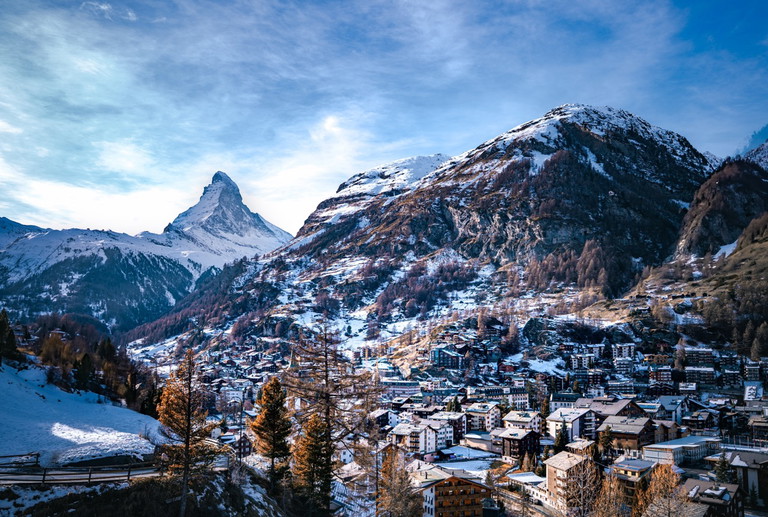
The village at the foot of the Matterhorn is probably the most famous tourist destination in the Western Alps. With the iconic rocky peak in its ''backyard", the once tranquil village became a mecca for mountaineers from the middle of the 19th century, initially mainly British mountaineers. Of the approximately 1,700 guest arrivals in Zermatt in 1857, 60 percent were English and only 16 percent German, ten percent Swiss and nine percent French.

But why the English in particular? At that time, it was customary for young noblemen and sons of the upper classes from England, Germany and Scandinavia, and in some cases also from America, to complete their classical education with a trip to historical sites and landscapes. In the 19th century, poets and writers such as Lord Byron, Sir Arthur Conan Doyle and Mark Twain also spent some time in the Swiss Alps on their travels through Europe.

They processed their impressions in their literary works. Doyle was so impressed by the Reichenbach Falls near Meiringen near Interlaken in the Bernese Oberland that he moved the "temporary" death of his hero Sherlock Holmes to this very spot (after protests from his readers, there was later a sequel to the detective series). Parkhotel du Sauvage in the center of Meiringen, built in 1880 and still run as a four-star hotel, was the model for the Englischer Hof, where Holmes and Dr. Watson stay in the novel during their case The Final Problem. Nearby, the Reichenbach cascades down into the valley in three stages before flowing into the Aare. The water mist can be seen from afar, especially after the snow melts or during foehn winds. A cable car was built for the numerous visitors as early as 1899.

Zermatt's mountain panorama
© Shutterstock
Zermatt's mountain panorama

Mark Twain climbed in Zermatt, among other places, where he wrote his text "Climbing the Riffelberg" in 1878. With a satirical undertone, the American writer dissects the hype surrounding expeditions and first ascents, which was in full bloom shortly before.

In fact, the 50s and 60s of the 19th century are apostrophized as the golden age of mountaineering. Many peaks were climbed for the first time at that time: the Wetterhorn in 1854, the Dufourspitze in 1855, the Eiger in 1858, the Aletschhorn in 1859, the Gran Paradiso in 1860, the Weisshorn and Monviso in 1861, the Täschhorn in 1862, the Barre des Écrins in 1864 and finally the Matterhorn in 1865. Twain was also able to observe the construction of the hotel on the Riffelalp during his stay. Today, the hotel is one of the leading five-star resorts in the area, with an unobstructed balcony view of the Matterhorn and the Mark Twain hiking trail right outside the room door.

The starting point of the tour is at over 3,000 meters above sea level, but can be easily reached from Zermatt with the Gornergratbahn. From the mountain station, the route continues leisurely and mostly downhill to the Riffelberg station. The Riffelsee, in which the Matterhorn is reflected, is probably one of the most photographed motifs on this tour.

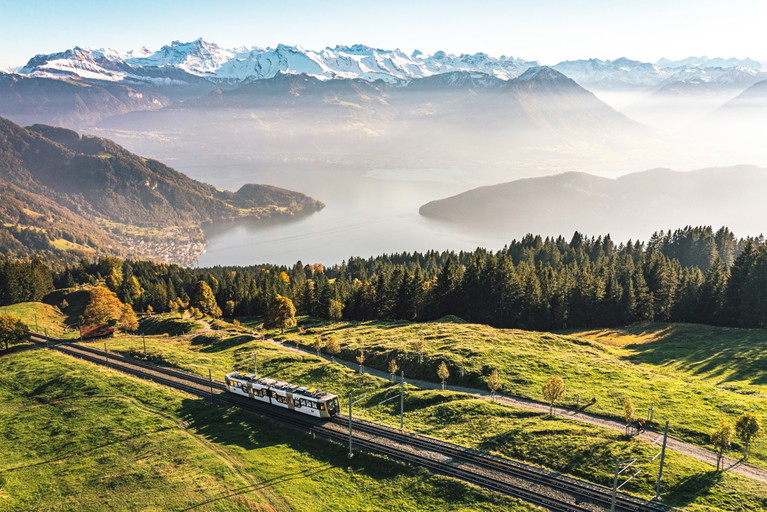
Twain was also on the Rigi, a mountain massif between Lake Lucerne, Lake Zug and Lake Lauerz in central Switzerland. In his book "A Trip to Mt. Rigi", he describes his ascent to the almost 1,800-meter-high summit of the "Queen of the Mountains"which took him three days at the time. Information boards along the route, which is steep in places and has a dramatic landscape, remind us of the arduous tour and the humorous and witty author. Today, two cogwheel railroads and seven gondola lifts take guests hungry for views from all directions to the top, from Vitznau to the Rigi Staffelhöhe station on a historic route: when it opened in May 1871, it was the first mountain railroad in Europe.

Rail links such as these were the "launch vehicles" of a development that then rapidly gathered pace in almost all of Switzerland's Alpine valleys. Hotel capacity tripled around Mount Rigi. Other mountain villages, which used to be inhabited by just a few farmers, were also transformed into tourist resorts with guesthouses and hotels thanks to better accessibility.

Gstaad in the Bernese Oberland, for example, was an unknown, small village until the opening of the Montreux Oberland Band in 1914. Thanks to the invention of the cogwheel railroad, even the steepest gradients could soon be overcome - a technical advance that Swiss railroad engineers subsequently made extensive use of. In 1893, the Wengernalp Railway between Lauterbrunnen, Wengen, Grindelwald and the top of the pass on Kleine Scheidegg was put into operation. With a length of just over 19 kilometers, it's the longest continuous cog railroad in the world.

The railroad not only provides passenger and freight transportation for the car-free resort of Wengen, it also serves as a feeder line for the Jungfrau Railway. It's further proof of the spectacular art of engineering and a symbol of the technical progress of the time, as it leads through the rock faces of the Eiger and Mönch up to the Jungfraujoch.

Construction began in 1896 and the entire line was completed in 1912. However, tourism had already developed before the railroads were built: travelers had been visiting the Bernese Oberland and hiking over Kleine Scheidegg since the end of the 18th century. The first hotel for tourists was built as early as 1840.

Today, all the towns in the region offer a variety of first-class addresses. Chez Meyers in the Hotel Regina in Wengen enchants with a magnificent view of the mountains. In the Gourmetstübli at Alpenblick hotel in Wilderswil, Richard Stöckli celebrates cuisine as an art form and creates first-class culinary delights using produce from the garden or from his own cows on the alpine pasture. In Grindelwald, the four-star Belvedere hotel, built in 1910, is just a few minutes' walk from the train station. There, guests are welcomed with a magnificent view of the mountains and pampered in the hotel's own gourmet restaurant 1910 - Gourmet by Hausers.

Switzerland Tourism / Christian Meixner
© Switzerland Tourism / Christian Meixner
Switzerland Tourism / Christian Meixner

Speaking of views: in the summit restaurant of the Schilthorn above Mürren, you can enjoy a 360-degree view without having to move. The rotating Piz Gloria at almost 3,000 meters above sea level offers breathtaking views. A tour takes 45 minutes, you get to see 200 mountain peaks, including the so called big three Eiger (3,967 meters), Mönch (4,110 meters) and Jungfrau (4,158 meters) as well as Mont Blanc, drink a James Bond-approved martini and eat a 007 burger - a reminiscence of the Bond film On Her Majesty's Secret Service, which was filmed here among other places. However, the secret agent was not the first prominent Briton to leave his mark on the small mountain village in the Bernese Oberland. Because the cradle of alpine ski racing was not in Adelboden or Wengen, but in Mürren.

In 1922, Sir Arnold Lunn flagged off the first slalom race in skiing history on a slope behind Hotel Jungfrau. The races in Mürren, which were held as the British national championships, followed rules that were later adopted by the International Ski Federation (FIS) and remained the basis for the first Alpine World Ski Championships, which were also held in Mürren in 1931. These are not the only firsts that the car-free village of 400 inhabitants has given to the history of skiing: The oldest women's ski club in the world was also founded here. In 1923, leading female ski racers came together at Hotel Palace to form the Ladies' Ski Club.

British Sports in the Alps

People in Graubünden were also quick to take advantage of the magnificent natural scenery around St. Moritz to attract guests. Here too, however, it was not the Swiss themselves or the Austrians who shaped tourism, but British guests. They imported sports that were previously unknown in Switzerland, such as polo and, in winter, curling, bobsleigh and skeleton.

Hotelier Johannes Badrutt, whose son later built the renowned Badrutt's Palace, proved to be particularly enterprising. He laid out a curling track and had a skeleton run (the Cresta Run) built and is regarded as the initiator of winter tourism around the picturesque lake. He's said to have lured the first guests from England to the Engadin with a bet: Badrutt promised them a December with sunshine and pleasant temperatures on his terrace in the fall.

In keeping with the spirit of the times, bets were placed. Badrutt's commitment: to cover all travel expenses if he has promised too much. The English came and lost the bet. In return, St. Moritz gained an image as a winter wonderland that still has a magnetic effect today (not only on the British aristocracy). The reputation of the Alps as a threatening and inhospitable region to be avoided was finally history.

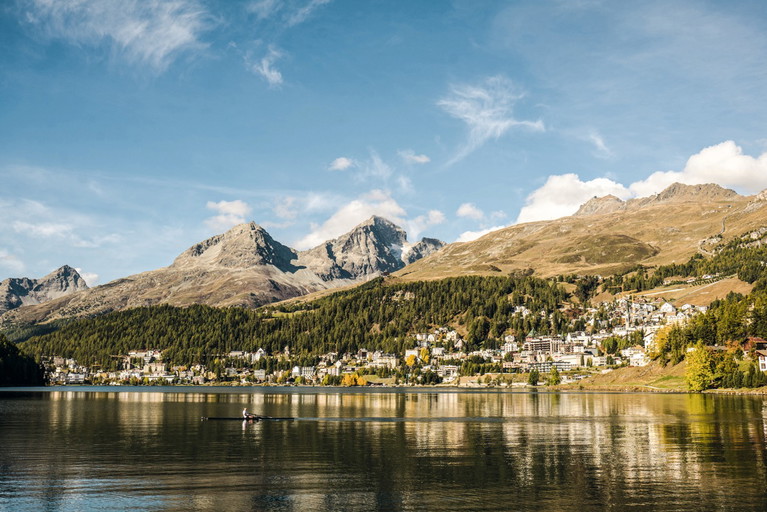
St. Moritz combines the charm of mountains and lakes. This glamorous town in the Engadin is one of the most famous winter sports destinations in the world.
©
St. Moritz combines the charm of mountains and lakes. This glamorous town in the Engadin is one of the most famous winter sports destinations in the world.

Klaus Höfler
Find out more
1 / 12