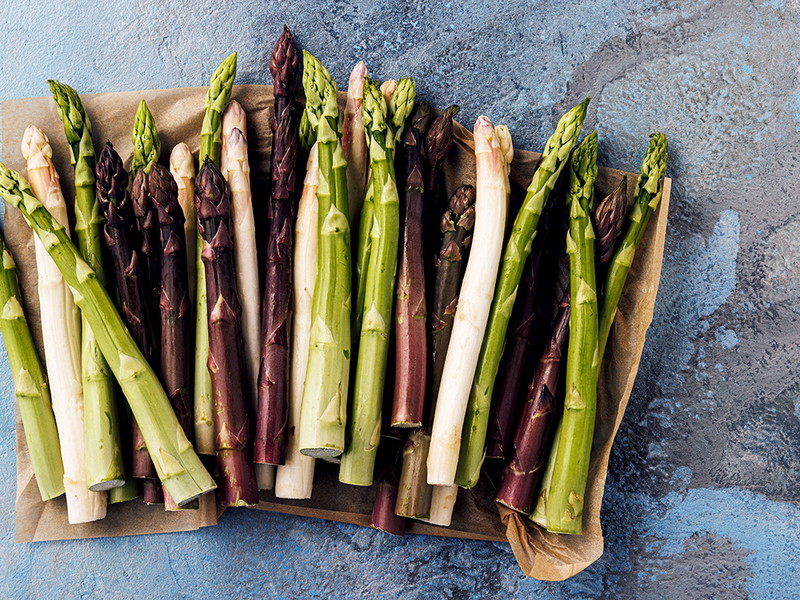
Whether white, green, mid-April until June 24, St. John’s Day. On this day, dedicated to the biblical John the Baptist, the harvest traditionally ends. Or, as an old farmer’s rule puts it: “Until St. John’s Day, don’t forget, eat asparagus for seven weeks!”
Why does the season stop then? Asparagus is a perennial plant that needs time to regenerate. It has an underground rootstock and shoots that sprout from buds in spring. The color of asparagus depends entirely on how it is cultivated: White asparagus grows beneath earthen mounds and is harvested just before the tips reach the surface. Since it never sees sunlight, it does not develop chlorophyll (the green pigment found in plants) and remains white.
Green asparagus, by contrast, grows above ground and is harvested when the spears reach a height of 20 cm to 30 cm. Exposure to sunlight triggers chlorophyll production, giving it a stronger, nuttier, and more herbal flavor than its pale counterpart.
Purple asparagus, meanwhile, is a distinct variety that owes its color to both sunlight and the plant pigment anthocyanin. Once considered overripe or inferior, purple asparagus is now regarded as a delicacy. Its flavor is intense, nutty, and subtly sweet with a hint of bitterness. Historically, purple asparagus has been cultivated for around 200 years, particularly in Liguria, Italy, as a variant of green asparagus. On a global scale, however, green asparagus dominates the market, with China, Peru, and Mexico as the leading producers.
“A POUND PER MOUTH”
Because it is labor-intensive to grow and difficult to harvest, asparagus commands a relatively high price. Producing 1 kg of asparagus requires approximately as much water as avocados. Early-harvested asparagus can be especially energy-intensive, often cultivated under heated soil or foil tunnels to accelerate growth. This raises both energy use and CO2 emissions. From an environmental standpoint, it is worth buying seasonal, local asparagus – and making sure nothing goes to waste.
This should not be difficult, since nearly all parts of the asparagus can be used. Peelings and trimmings make an excellent base for flavorful soups or broths. It also helps to estimate portion sizes properly. The old German saying, “A pound per mouth”, still rings true: roughly 500 grams (equivalent to about 1 pound) per person of white asparagus as a main course, or 375 grams of green asparagus not requiring peeling. As a side dish, plan for 250 grams of white, or 180 grams of green, asparagus per person.
HEALTH BENEFITS
Comprised of more than 90 percent water, asparagus is extremely low in calories – around 17 kcal per 100 grams – yet packed with fiber, minerals such as calcium, and vitamins A, B, C, E and K. Particularly noteworthy is its potassium content, important for muscle and heart function and for regulating blood pressure.
In the body, potassium works wherever salt is active – but with the opposite effect. It is well known that being overweight, a lack of exercise, and stress raise blood pressure – and that salt-sensitive individuals can experience further increases through excessive sodium intake. Conversely, a low-salt diet can lower blood pressure, and eating potassium-rich foods can help even more. So vegetables and fruits, including asparagus – with 270 mg of potassium per 100 grams – are powerful allies.
A DELICATE VEGETABLE
Asparagus is, however, a highly perishable vegetable. After harvesting, it quickly loses freshness, aroma, tenderness, and flavor. Fresh asparagus tastes best when it is picked the same day. If storage is unavoidable, wrap the stalks in a damp cloth and store them in the refrigerator for up to four days.
Asparagus can also be frozen: Peel the spears, wrap them in aluminum foil or freezer bags and keep them in the freezer for up to six months. To prepare, simply place the frozen spears straight into boiling salted water.
For maximum enjoyment, attention to freshness begins when shopping. Check the cut ends – they should be smooth, light, and moist. If white asparagus shows pink discoloration or the stalks have woody ends, it indicates late harvest or insufficient cooling. Fresh asparagus squeaks when rubbed together and is notably fragile.