Kulinarik in Caorle: Es tut sich was in Klein-Venedig
Die besten Adressen am beliebten Ferienort an der Mündung der Livenza.
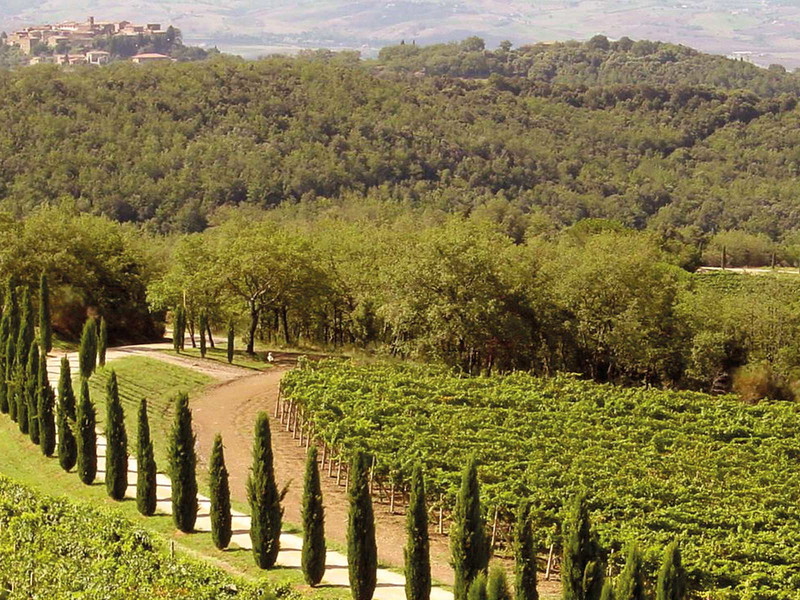
Wine connoisseurs are confused: Which is now actually the traditional Brunello? Falstaff asked around among the local winemakers and found out something surprising.
Traditional? Modern? This question does not arise for me. It has to be good," says Giacomo Neri of the Casanova di Neri winery. A good Brunello must be characterized by high quality, uniqueness and recognizability. Whether large or small wooden barrels, is for him a purely cellar-technical question and depends on the sites and the quality of the grapes. Thus he develops his basis Brunello exclusively in the old large wooden barrel. The "Tenuta Nuova", on the other hand, matures in barrels of 300 to 600 liters. He does the same with the "Cerretalto", which comes from a single vineyard with very stony, slate soil.
Paula Gloder of Poggio Antico makes a similar mix. The standard Brunello is aged in large wooden barrels of Slavonian oak. For lovers of modern style with more fruit and fullness, there is Brunello Altero. Instead of three, it is aged for only two years in French tonneaux. The Riserva is first aged for one year in 500-liter barrels, then for two and a half years in large wooden barrels.
Hayo Loacker of the Corte Pavone winery also does not want to commit to barrel sizes. After fermentation, which also takes place in wooden barrels, he uses small wooden barrels for the first year, and then larger barrels as the wine ages. More important than size and type of barrel for Hayo Loacker as a biodynamic winemaker is the accurate selection in the vineyard. At Corte Pavone we do not distinguish between individual vineyards or plots, but from vine to vine. Only vines with balanced growth are suitable for Brunello, and these can be different from year to year depending on the weather.
Giancarlo Pacenti, on the other hand, relies fully on barrique at his Siro Pacenti winery. Through the small oak barrel, he said, the connection between soil and wine can be brought out best. In addition, the use of barriques - he renews about 25 percent of the barrels every year - guarantees him greater cleanliness. Due to the thinner barrel staves, the oxygen exchange in the wine is greater, the wines become softer and accessible earlier, while still being very long-lived.
Elisabetta Gnudi, owner of Caparzo and Altesino, sees it quite differently. She describes herself as a traditionalist through and through and does not have a single barrique in her cellars. With the aging in large wooden barrels, the wines would get fine fragrance and elegance. In other areas, the use of barriques may make sense, Gnudi says, but not in Montalcino. They should stick to tradition, otherwise, she fears, they will lose their identity.
Giuseppe Bianchi of Ciacci Piccolomini also has barriques in his cellar. But he stores his Brunello exclusively in large wooden barrels, he says categorically. Giulio Salvioni has a similar approach, although tradition in his production also includes the renunciation of pure yeasts and other powders and additives.
The fact that the style of the wine can be linked to the type of wooden barrel can also be seen in the example of the Il Poggione winery. These wines are known in the scene as great classics. Although they are aged in large wooden barrels, since 1996 these barrels are no longer made of Slavonian oak, but of French oak. The tannins of Sangiovese would simply be finer and more elegant with the French wood, says Fabrizio Bindocci, director of the winery.
In the municipality of Montalcino - 40 kilometers south of Siena, 40 kilometers as the crow flies from the sea - there are 3500 hectares of vineyards, 2100 of which are used for the production of Brunello di Montalcino DOCG. 220 plants there fill an average of nine million bottles a year. Brunello may only be made from the Sangiovese grape; it must be aged for five years, at least two of which must be in wooden barrels, and six years for Riserva.
"Brunellopoli, scandal of fake Brunello!", sounded the press at the opening of Vinitaly 2008. In several wineries in Montalcino, the cellars were sealed and large quantities of wine were confiscated. The suspicion: unauthorized blending of Sangiovese with other grape varieties that have no place in Brunello. After detailed investigations, however, very little came out in the end. Only just under 1 percent of the wine was found to be not in compliance with the law.
The scandal (fortunately) did not dampen the sales success of Brunello. On the contrary, the volume continued to rise and reached a peak in 2011 with 9.5 million bottles. The supposed scandal even helped Brunello gain more attention, according to Fabrizio Bindocci, president of the Consorzio. "Brunello is now the most closely controlled wine, and insinuations of lack of purity no longer exist." Today, the question about Brunellopoli causes only a tired smile. The Brunello scandal is history.
Arrival
By plane direct flights from e.g. Frankfurt or Munich to Florence (from Vienna via German cities) - then approx. 100 km drive to Montalcino.
From Falstaff Magazine No. 02/2014