While cookbooks used to be the main source of inspiration in the kitchen, today this role is often taken over by short food videos. These platforms offer endless ideas—but not all of them work in real life. Many are staged or difficult to recreate. That makes it even more interesting when a recipe actually delivers—and can be explained in a straightforward way.
One such example comes from content creator “saucceats”, who tests a dessert made from just two ingredients: warm milk and freshly pressed ginger juice. Inspired by another creator, he tries it himself—wondering whether it really works or is just made for social media.
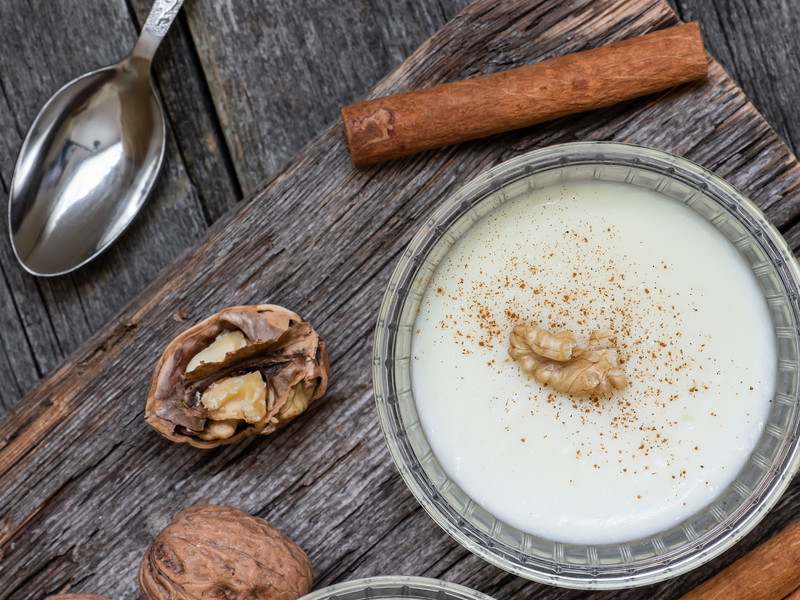
The dessert is said to come from Shanghai and looks similar to a classic blancmange. Despite its simplicity, it develops a smooth, pudding-like texture that makes you wonder how it works.
A Simple Biochemical Process
There is no trick behind it, but a clear biochemical reaction. The proteins in milk—mainly caseins—react with enzymes in fresh ginger. These enzymes act as proteases, breaking down parts of the milk proteins. As a result, the milk gently coagulates and forms a smooth and stable texture.
The preparation is just as simple. The milk is heated to about 80°C, then the freshly pressed ginger juice is added and stirred in briefly. After a few minutes of resting, the mixture begins to thicken. A quick test: if a spoon placed on top stays in place, the pudding is ready.
The result is a surprisingly creamy dessert that shows how natural reactions in food can be used in a very simple way. Two unusual ingredients come together to create something balanced and refined—at once a small kitchen experiment and a good example of how much science can be found in cooking.