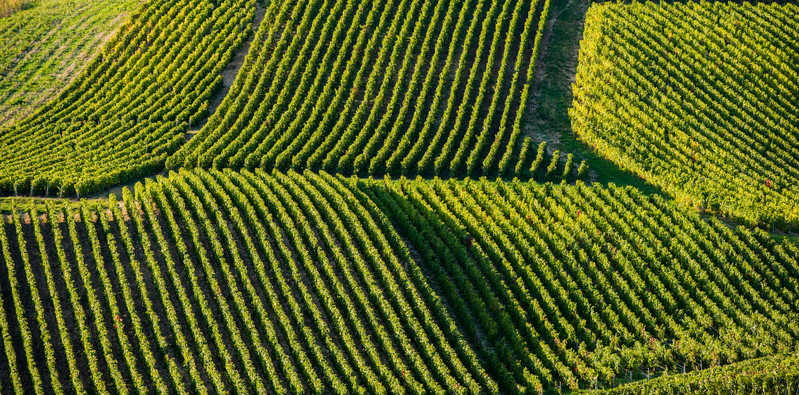
The Colombard is also one of those varieties whose products many connoisseurs know without ever having come into contact with the name. Colombard is one of the main grape varieties for the production of Cognac. So it is of course not surprising that one of the main Colombard vineyards can be found in the Cognac region in the north of Bordeaux. The Colombard originally comes from the Charente, where it was born as a natural cross between Chenin Blanc and Gouai Blanc. It was first mentioned in 1706. Until not so long ago, Colombard was completely unknown as a wine from France, as the grapes were mostly delivered to Cognac producers. The vineyard areas used for actual wine growing shrank. At the same time, however, it celebrated a happy resurrection in California, especially in the Central Valley, where it is still used on a large scale today to make very inexpensive, fruity wines that can be drunk young, such as bag-in-box wines, often rather medium dry. The growing demand for fruity wines in the inexpensive range inspired the Vignerons de Plaimont in Gascony to produce racy, piquantly fruity wines. Colombard is strong and vigorous, responds well to different types of training and has hard wood. The variety is produced as a pure variety or in a blend with Ugni Blanc or Sauvignon Blanc. France's vineyard area is around 7,000 hectares compared to 36,000 hectares in California.
This grape variety is also known by the name of:
Bardero, Blanc émery, Charbrier vert, Donne verte, Donne rousse, Coulombier, Colombar, Colombard Bijeli, Colombeau, Colombié, Colombier, Bouteillan, Cubzadais, Chabrier vert, French Colombard, Gros blanc doux, Gros blanc roux, Guenille, Quene tendre, Quene vert, Pied tendre, Martin côt, Queue tendre, Queue verte, Semilao, West's White prolific, Rousse