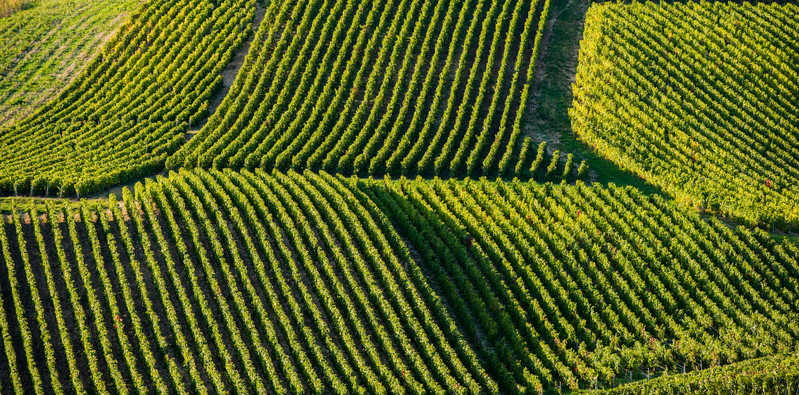
Named in France after an old Provençal dialect, Ugni Blanc originally comes from Tuscany, where it is known and widespread as Trebbiano Tuscany. He probably came to Provence in the 14th century, at the time of the popes' residence in Avignon, and from there he moved on to the Languedoc and the Charante. The large vineyard area of well over 80,000 hectares in France is explained by the fact that, with its rather neutral character and high acidity, it is ideal for the distillation of high-quality spirits such as Cognac and Armagnac. It sprouts late and is therefore hardly at risk of frost even in less suitable locations. It is fairly disease-resistant and responds well to a variety of soils, but is also vigorous and high-yielding, so careful pruning is required to achieve good quality. However, the Ugni Blanc must not be exposed to harsh winds, and shoots sometimes die for inexplicable reasons, a disease known in Australia as “the dead arm”. With the falling demand for hard liquor, people in Gascony began to produce Ugni Blanc very successfully as a still wine, as a single variety or in a cuvée with Colombard and/or Sauvignon Blanc. These wines are fresh, lively, fruity and their aromatic structure is often reminiscent of Sauvignon Blanc, although it does not achieve its finesse. There are of course large areas in his home country, Tuscany, outside of Europe Argentina has the largest vineyard area with around 2,500 hectares, and some vineyards also produce crops in Greece, Australia and South Africa.
This grape variety is also known by the name of:
Blanc De Cadillac, Blanc bacca, Cadet, Blancoun, Buzzetto, Bobiano, Castillone, Blanc Auba, Boriano, Boriano de cadillac, Bonebeou, Bubbiano, Chatar, Buriano, Chator, Elba, Cadillate, Coda di Cavallo, Coda di Volpe, Biancone, Falanchina, Castelli, Castelli Romani, Clairette d'Afrique, Clairette de Vence, Juni Blan, Brocanico, Brucanio, Muscadet Aigre, Gredelin, Clairette Ronde, Lugana, Procanico, Procanico dell´Elba, Rossan de Nice, Rusciola, Santoro, Passarena, Uni Blan, Passerina, Perugino, Procanico Portoferraio, Saint Emilion, Saint Emilion Des Charentes, Rossula, Spoletino, Romani, Rossela Blanco, Tribbiano, Tribbiano Forte, Rossetto, Roussan, Roussea, Uva Bianca, White Shiraz, Uni Blance, Unji Blan, Trebbiano di Cesene, Trebbiano d'Empoli, Trebbiano di Empoli, Trebbiano di Lucca, Trebbiano di Cesena, Trebbiano di Tortona, Trebbiano di Toscana, Trebbiano Fiorentino, Trebbiano Albano, Trebbianone