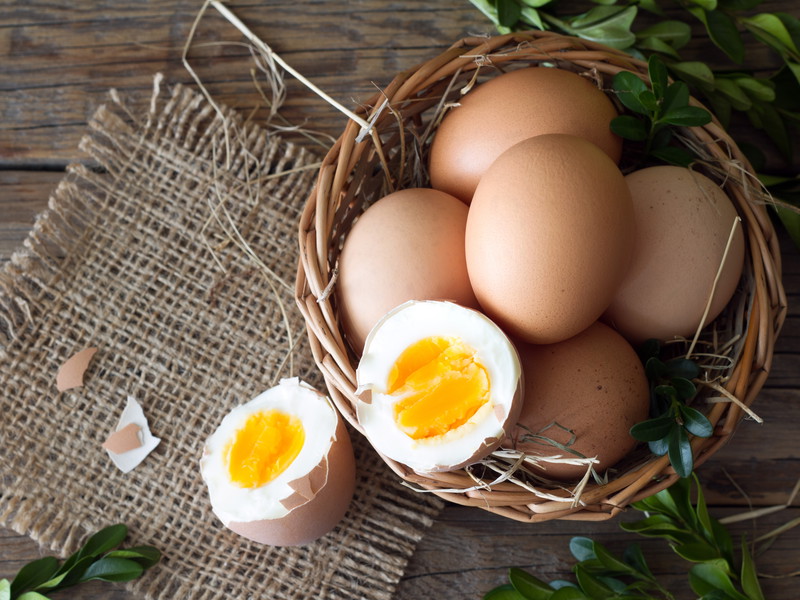
Hard, soft or sous-vide? Creating the perfect breakfast egg is a science in itself. An Italian research team now claims to have found the ultimate method – and it's neither traditional boiling nor slow-cooking. Instead, they have found that alternating between boiling and warm water when cooking an egg results in better consistency and more nutrients.
The culinary challenge is simple, but tricky: while egg whites coagulate and solidify at around 85 degrees Celsius, egg yolks remain in an optimal creamy state at only 65 degrees. Traditional methods for hard- or soft-boiled eggs require boiling at 100 degrees and often lead to compromises. Even the sous-vide technique, where eggs are cooked for an hour in water heated to 60 to 70 degrees, does not always produce the ideal consistency, with the egg whites usually ending up undercooked.
Th ideal texture
The new method solves this dilemma by utilizing so-called "periodic cooking": Instead of exposing the egg to a constant temperature of 100 degrees, it is first immersed in boiling water for two minutes and then placed in water at around 30 degrees for two minutes. This cycle is repeated for a total of 32 minutes. The result: Egg whites that are properly set, and a yolk that remained at a constant 67 degrees – the ideal temperature for a creamy texture.
The team led by Pellegrino Musto from the National Research Council in Pozzuoli not only simulated the method mathematically, but also tested it in practice. They used state-of-the-art techniques such as infrared spectroscopy, nuclear magnetic resonance and mass spectrometry to analyze the chemical changes within an egg during the cooking process.
The study showed that periodic cooking leads to a more even consistency: While soft-boiled eggs often have an overly runny, partially undercooked yolk, yolks cooked using the periodic cooking method remain entirely creamy. The egg whites, on the other hand, become firmer compared to the sous vide method, but not as dry as hard-boiled eggs. The researchers were also able to prove that periodic cooking retains more valuable nutrients such as flavonoids and amino acids than traditional cooking methods.
Don't miss out!
Sign up now for our .