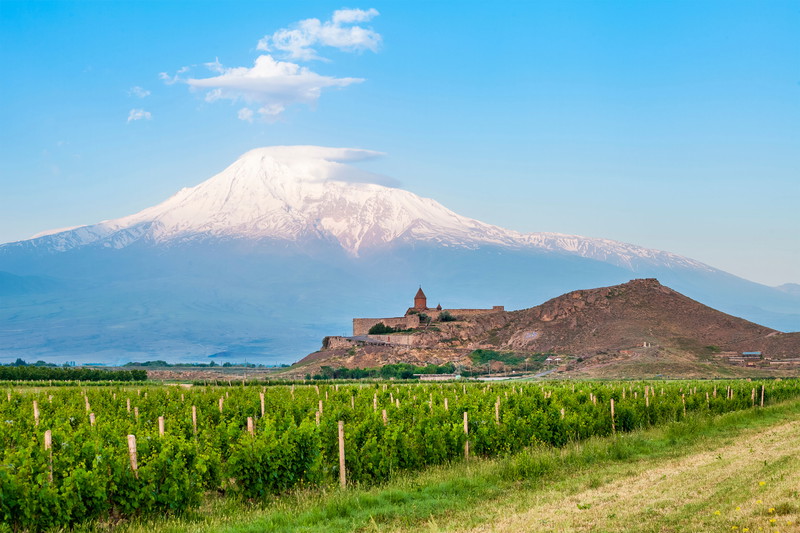
It has now been proven that the origins of viticulture lie in Armenia. Archaeological excavations of a vineyard and the discovery of grape seeds and tools for wine production prove that viticulture was already practiced here between 4,000 and 6,000 BC. According to the Bible, the Armenian plateau borders Mount Ararat, where Noah landed with his ark and subsequently planted the first vine. Thereafter, viticulture flourished but was constantly interrupted by the domination of the neighbouring Muslim countries. Today, great efforts are being made to achieve quality, and there is increasing investment in the vineyards and the wineries in the small state that used to belong to the USSR. The climate in the foothills of the Caucasus is continental, with tropical influences in the lower regions. With only about 500mm of rainfall, Armenia is one of the driest wine-growing regions in the world, comparable in Europe with Languedoc-Roussillon. Therefore, mildew and fungal diseases do not play a significant role, but many vineyards have to be irrigated. A variety of autochthonous grape varieties are cultivated, the best known being Rkatsiteli, also found in other countries in the east. In contrast to most wine-growing countries in the world, about 90% of Armenia's vineyards are still planted with autochthonous vines. In Europe, people are gradually becoming increasingly aware of the wines from Armenia, and it should also be noted that the country can boast a remarkable production of brandies.