 Route
Route

Vegan crème brûlée
Philip Khoury’s vegan take on this classic dessert: a close relative of crème caramel, featuring...

Following the introduction of vegan-vegetarian cooking, voices are now being raised in favour of specialised training that meets the culinary requirements of Judaism and Islam.
After the introduction of the vegan-vegetarian cooking apprenticeship in Austria in June 2024 caused quite a stir, the SÖZ (Social Austria of the Future) party is now calling for the creation of a specialised apprenticeship for halal and kosher chefs in Vienna. This demand aims to meet the diverse culinary needs of the Muslim and Jewish communities living in the federal capital. Specialised teaching would not only meet the culinary needs of the Muslim and Jewish population, but also enrich the city's cultural diversity and gastronomic offerings, according to the small party.
But what do halal and kosher actually mean, why are these guidelines so important and what would the new training mean for the gastronomy scene?
The term halal comes from Arabic and means permitted or permissible. In the Islamic tradition, halal refers to everything that is permitted according to the provisions of Islamic law, the Sharia. This includes not only food, but also behaviour, clothing and financial transactions. In the context of food, halal means that certain rules and regulations must be followed for a product or food to be recognised as halal. For example, meat must come from an animal that has been slaughtered in a certain way (dhabihah). The name of Allah is pronounced and the animal is killed with a quick cut across the throat to drain the blood completely. Pork and all products made from it as well as alcohol and alcoholic products are generally prohibited. Halal food must be prepared under hygienic conditions and the utensils used must not come into contact with non-halal (haram) substances.
These regulations are intended to ensure that the food is pure and healthy for Muslims. However, halal goes beyond mere compliance with food regulations and encompasses an ethical and spiritual approach to consumption and lifestyle. Among other things, it promotes animal welfare, sustainability and social responsibility.
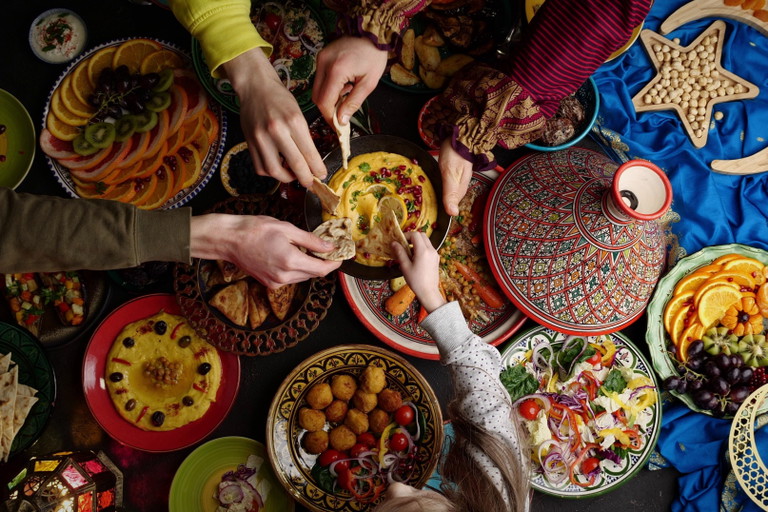
The term kosher comes from the Hebrew and means suitable or pure. In Jewish tradition, kosher refers to food that complies with the kashrut regulations laid down in the Torah. These rules determine which foods may be eaten by Jews and how they should be prepared and consumed. Only certain animals are permitted for consumption. This includes ruminants with cloven hooves such as cattle, sheep and goats, as well as certain types of poultry. Seafood must have fins and scales, so shellfish and catfish, for example, are not kosher. Animals must be slaughtered as in Islam. Dairy and meat products may not be cooked, served or eaten together, which is why many Jewish households have separate kitchen utensils for dairy and meat.
Certain foods are strictly forbidden, including pork and all products made from it, as well as insects. A kosher diet is a central aspect of Jewish life and has both religious and cultural significance. Observance of the kashrut regulations is not only intended to promote spiritual purity, but also to convey a conscious and respectful attitude towards food and its origins.

Kosher and halal chef training could enrich the gastronomy scene by meeting the growing demand for religiously specialised dishes and thus expanding the culinary offering for diverse customer groups. On the other hand, such training could fragment the catering scene by introducing additional specialised standards that could be difficult to implement and financially burdensome for some businesses.
Sign up now for our newsletter.