Anniversaries always are a time of reflection – and in the case of the Armagh Shiraz, they tell the story not just of one vineyard, but of an entire region and a pioneering family. “When our grandfather Jim finished his oenology degree in 1947,” Sam Barry says, “he became Australia’s 17th qualified winemaker – and Clare Valley’s first. Clare Valley at that stage had five wineries, and they never had had a qualified winemaker there,” he explains. Times were different then: “It was wineries who applied to grads rather than vice versa. The Clare co-op applied to Roseworthy and Grandpa took over that role. The co-op had about 35 growers, and he transitioned these growers away from Gordo and Palomino towards Riesling, Malbec, Shiraz and Cabernet – in fact away from fortified wines which were then the mainstay of the Australian wine industry towards still table wines. He also created a nursery at the co-op.” Jim Barry then gave cuttings of the new varieties to the growers. “These were the foundation of the Clare Valley wine industry,” Sam Barry says.
Seeing it through
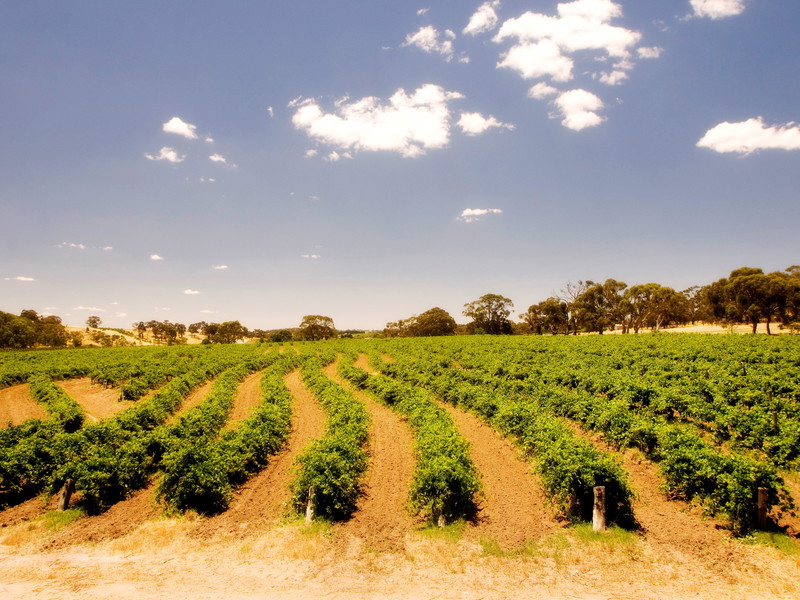
While Jim Barry worked for the co-op, he purchased his first acres of land, “from a Scotsman who was just grazing his cattle there. It was a parcel of land that Jim thought had the best potential for Shiraz and Malbec,” says Sam Barry. “He discovered that it had alluvial soil, while the Clare is based on shales. But this little parcel had a little sand and a layer of gravel.” This is where Jim Barry planted his first vines in 1964 – in the Armagh Vineyard. He planted gradually, over years, as finances allowed. The first plantings were of Cabernet and Malbec, in 1968 he planted Shiraz.
Sam Barry also tells us that this vineyard holds a formative experience for his father Peter Barry: “Dad’s first memory as a 9-year-old was late in 1968 and early 1969 – planting the vineyard. This was before the days of irrigation; his first memory was his brothers filling up drums of water and pouring water on the withering vines. It gave a strong message to a 9-year-old: if you start something, you see it through. They could not let it go, because they had invested so much, Jim had planted them in the weekends, and we have always had a strong emotional connection to this block.” All of Nancy and Jim Barry’s three children were part of the business: of Peter’s older brothers, Mark became the winemaker, John the viticulturist.
From father to son, from Jim to Peter
“Grandfather was very humble when he first made his own wines,” says Sam's brother Tom Barry, explaining that the first wines that Jim Barry made were not named after himself or the family name, but were called Saint Clare Cellars. These first wines, incidentally, were made at Wendouree. Tom Barry also remembers the collaborative spirit prevailing in the valley: in the late 1960s, Jim Barry helped the Taylor family establish their Wakefield estate and was friends with Wolf Blass. Jim Barry was finally able to build his own cellar in 1973, in readiness for the 1974 harvest. That little boy who had witnessed his family’s hard work and dedication to the vineyard also ended up studying viticulture and then left to work the 1983 harvest in Bordeaux – an experience that was just as formative. While Jim Barry had founded the estate, it took his son Peter to rename the estate and explore export markets. “It was really dad who said we are called Jim Barry wines and we should be proud of that. It was dad who developed the international markets.”
Creating The Armagh Shiraz
“Grandpa’s first philosophy was that we have to grow our own fruit – our own grapes,” Sam Barry says. Both Tom and Sam Barry emphasise that this philosophy still is key today: “We have 350 acres of vineyard across 18 to 19 sites and we could not make the Armagh or our Florita Riesling if we didn’t grow our own fruit. That is a big part of our history and of our future.” As Peter returned from his harvest stint in France, he also brought back ideas. He took two key takeaways from his trip in Europe, Sam Barry says. “Peter knew we needed to have a distribution model that serviced the world and a wine that we could anchor ourselves to.” Peter’s ideas were clear: “At the time, Shiraz was really out of fashion,” Sam Barry recounts, but he also says his father returned with a realisation: “He knew from going to France that Australian Shiraz was unique – and he knew we could not compete with Cabernet from Bordeaux.” He wanted to create this wine and discussed it with his family. “Grandpa said if you are going to make this wine, it will have to come from the Armagh block, from the gravel and sand.” He knew that this was the ideal fruit: “You really get tiny berries, it ripens early so you get really good acidity, with a great juice to skin ratio. In 1985 we made our first Shiraz from that parcel.”
An audacious move
The 1985 vintage of the Armagh was launched in 1989. At the time, the only Australian wine that achieved the price of a fine wine was Penfolds Grange – and Peter Barry wanted to launch the Armagh at a higher price to make a statement. “But Jim said it would be disrespectful to my friend Max Schubert,” Sam Barry says. “Outside Adelaide, nobody knew who we were, so this was quite audacious.” The family also knew that they could only get away with charging that price by presenting absolute quality – and they were proved right: “The people who bought it and endorsed that it was very good.”
Stylistic evolution
Not all Shiraz grown at the vineyard goes into The Armagh Shiraz. Of the 5.2 hectare vineyard which yields around 25hl/ha, only half the barrels make it into The Armagh – the other half are declassified. This results in an average annual production of just 5,000 bottles. There also are years when no Armagh is made at all – this was the case in 1986, 2003 and 2011. Likewise, the style has evolved since the first vintage of The Armagh was released in 1985: initially there was just American oak, then in the early 1990s French oak was also used, as of 1994, exclusively French oak has been used.
READ THE TASTING NOTES HERE