Skip to content

Chef Giorgio Pignagnoli: “A Restaurant Should Be Full of Guests Before It Chases a Star”

Chef
Lithuania
Interview

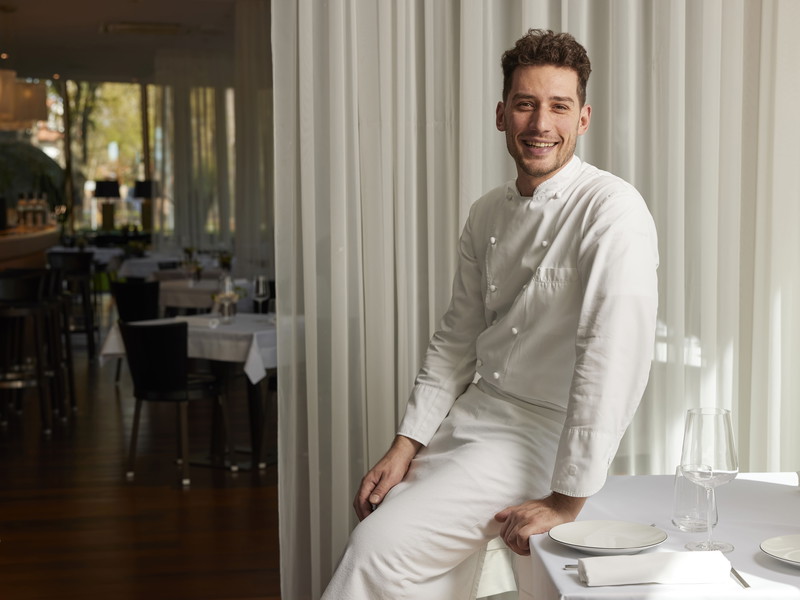
Italian chef Giorgio Pignagnoli never planned to settle in Lithuania. After years spent in Michelin-starred restaurants in Milan and Paris the Italian chef arrived on the Baltic coast for what was supposed to be a brief consulting project. Years later, he is still here.

In this conversation, he reflects on growing up in an Italian household where food was part of everyday life, the lessons learned in some of Europe’s most demanding kitchens, and how Lithuanian ingredients — from dairy to smoked fish — are quietly influencing his cooking.

Going back to your childhood — what first drew you to cooking?

I think it was my mother and my grandmother. I was born and raised in a very traditional Italian household. My mother didn’t have a job outside the home — she took care of the house and the children — and she cooked constantly, especially for holidays.

She bought most of her products at the market rather than the supermarket. I remember coming home from school and seeing vegetables waiting to be peeled. My mother was really my first chef.

We made everything fresh: gnocchi, pasta. Sometimes we even had a whole lamb that would be cut and prepared at home. I grew up surrounded by these smells, tastes, and the atmosphere of the kitchen. Food was simply part of our culture and daily life.

How did studying at ALMA shape your culinary perspective?

Arriving at ALMA felt like entering another life.

I actually wanted to become a chef when I was about seven years old. But during high school I started questioning that decision. I even considered studying something completely different, like economics. I thought maybe spending your whole life in a kitchen wasn’t the best path. At that time my father played an important role. He slowly started buying gastronomy magazines for me and occasionally booked cooking classes, just to keep my passion alive. After finishing high school I felt a bit lost, so I began working as a waiter. After about a year I realized that maybe going to ALMA wasn’t such a bad idea for my future.

The school itself is amazing. It’s located in a historic mansion surrounded by gardens, and the level of the classes is very high. Many of the professors were idols in the industry at the time. It’s an intense experience — you absorb as much as you can. You spend six months at the school, and then they send you straight into the restaurant world. I ended up at the two-Michelin-star restaurant in Milan, where I stayed for five years.

Honestly, almost everything. ALMA teaches you not only cooking techniques but how to behave and function in a professional kitchen. You learn structure, discipline, and how to treat ingredients with respect. It’s about understanding food deeply — not wasting it, not abusing it.

Another important lesson is craftsmanship — artigianalità. Every day you make things from scratch. It’s impossible to make something exactly the same every time, but the goal is always to improve. The focus is on understanding the product and cooking it in the best possible way.

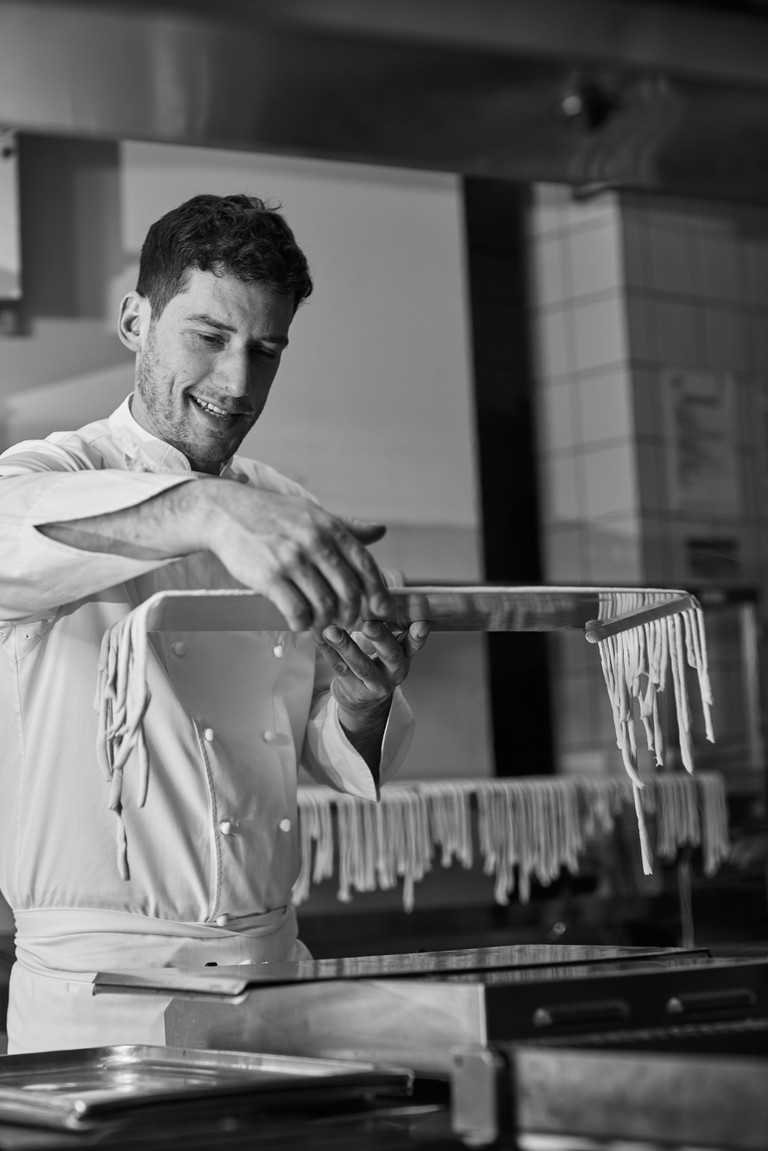
Working in sections is another fundamental concept. Each section of the kitchen becomes like your own small domain. You’re responsible for everything — preparation, ordering ingredients, refreshing products, organizing the workflow. Through that system you learn independence. First you master meat, then fish, then starters, and so on. When you’ve worked through all these sections, you can truly manage a kitchen because you understand every part of it. If you try to run a kitchen without understanding these areas, it becomes difficult. You won’t be able to guide or challenge your team effectively.

You’ve worked with chefs such as Claudio Sadler, Luigi Taglienti, and Yannick Alléno. What unique lesson did each of them teach you?

From Claudio Sadler, the biggest lesson was respect for ingredients and avoiding waste. I remember moments when someone threw away leftover pasta with tomato sauce from the staff meal. Sadler would become furious. That stayed with me — I was only twenty years old, but it made a huge impression.

From Luigi Taglienti, I learned elegance. He influenced the way I think about flavor and presentation. His cuisine is very clean and refined, but also easy to digest. That philosophy is probably the closest to my own style today.

From Yannick Alléno, I learned creativity and presentation on another level — and also how to manage a very large kitchen team. In his kitchens you have forty or fifty people, chefs from many nationalities, multiple levels of production. It’s almost like entering another world.

Which of those experiences pushed you the furthest outside your comfort zone?

Definitely France. When I arrived in Paris I couldn’t speak French, so language was the first barrier. On top of that, being Italian in France comes with a certain historical rivalry. 

The kitchen was extremely competitive. Even if people were friendly, everyone wanted to succeed. We worked very long hours — sometimes fifteen hours a day — in a high-pressure environment. But it wasn’t really about discomfort. It was about intensity. Everyone around you had made the same sacrifices to be there — chefs from Finland, Norway, Italy, all over the world. You could feel the energy and ambition in the room.

I wanted to prove that I deserved to be there. When you arrive in such a kitchen, you start at the bottom and you have to demonstrate your value.

Giorgio Pignagnoli

Chef

Giorgio Pignagnoli

Chef

How did that atmosphere affect you personally?

It pushed me to work even harder. I wanted to prove that I deserved to be there. When you arrive in such a kitchen, you start at the bottom and you have to demonstrate your value. If you don’t, you remain stuck doing tasks you may not enjoy. As a young chef you want to work with the best products — imagine seeing a seven-kilogram turbot arrive in the kitchen. You want to be the one who cuts it, cooks it, understands it.

You don’t want to spend your entire time peeling potatoes. So you push yourself to grow.

Your plating has a very clean, subtle French influence. Are there particular techniques from French haute cuisine that shaped your cooking?

At a high level, Italian cuisine has already absorbed many French influences over the centuries — sauces, fillings, and certain techniques. 

People often think Italian cuisine is only about pizza, carbonara, or tiramisu. Those are famous dishes, but they’re only a small part of the story. Take something like tartare. People think it’s French, but what really makes it French or Italian? At the end of the day it’s simply raw meat cut into pieces. If you season it with olive oil, maybe it becomes Italian. If you add mustard, cornichons, and egg, it feels French. The cuisines are actually very close and have influenced each other for centuries.

How did you end up in Lithuania?

To be honest, I didn’t really plan to end up in Lithuania — it just happened. I was working in Liguria, and after two years my collaboration there came to an end. At that moment I felt it might be the right time to work abroad.

This opportunity initially came as a four-month consulting project. I arrived thinking it would be a short stay. But during that time I developed a great relationship with Loreta, the owner. After the consultation ended, she asked if I could come back for the New Year’s Eve event. I said, “Va bene, only for New Year’s Eve,” and planned my holidays around it.

After that she asked if I could return again and renew the contract. Since then it has continued in the same way — we extend the contract every seven or eight months. And honestly, I enjoy it here. It works well.

Are you satisfied with how things turned out?

Very much so. At the beginning I was a bit nervous because I didn’t know what to expect — the kitchen, the team, the environment. I started slowly, looking around and understanding what could be improved. I focused on what kind of work we could introduce and which collaborators I could bring from Italy. Eventually my sous-chef and another colleague joined me.

Little by little we improved the kitchen together. When you see things developing in a positive direction, it’s very satisfying.

Since arriving here, how have Lithuania and its ingredients influenced your cooking? How do you approach blending Italian culinary roots with Baltic ingredients?

That’s something I’m still exploring. In Palanga it can be difficult to find certain products, especially fresh ones. For example, fresh fish often needs to be pre-ordered many days in advance. During the low season some suppliers simply stop delivering. At first I tried to build menus around ingredients I was used to from Italy, but I quickly realized that the situation here was very different. The language barrier also makes it harder to connect with small local producers. 

In a way it’s a kind of freestyle. I visit local restaurants and try to understand what people here enjoy eating — the flavors that feel familiar to them. Then I translate those flavors into the language of my kitchen.

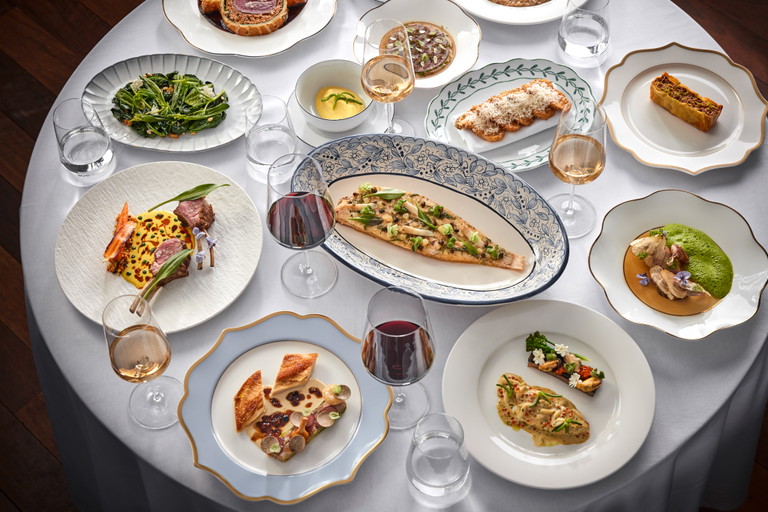
Certain elements are very characteristic here: potatoes, sour cream, smoked fish, creamy sauces, buttery flavors. Butter is much more dominant here than olive oil. 

Even though my cuisine is largely French in technique, here I adapt it. For example, I used to prefer very clean vegetable reductions or glazes. But here I often add a little cream to make the flavor rounder and more comforting for the guest. It’s about speaking a language that people understand.

Are there Lithuanian ingredients that particularly excite you as a chef?

Yes, definitely. Potatoes are incredibly versatile and central to the cuisine here. The dairy products are also fantastic — especially butter and sour cream.

The strawberries surprised me the most. But the first season I experienced here was incredibly short. We bought them from a small local farmer, and when we called a week later to order more, he told us the season was already finished. Maybe ten days in total!

I also enjoy working with smoked fish, though sometimes the smokiness can be very intense. There are many great products here. The real challenge is simply learning where to find them and ensuring consistent quality.

Here I try to remove my ego from the process. If a dish doesn’t work, we change it.

Giorgio Pignagnoli

Chef

Giorgio Pignagnoli

Chef

What gives you the most satisfaction in your work today?

Right now, it’s freedom. For the first time I’m not working in a Michelin-star environment where every second carries immense pressure. Here I focus more on understanding what makes guests happy. 

Sometimes chefs become trapped in their own ideas. They think about dishes only from their own perspective — extreme tastes, unusual textures — but guests might not enjoy that. Here I try to remove my ego from the process. If a dish doesn’t work, we change it. It doesn’t matter how many hours I spent developing it. If guests don’t enjoy it, it simply doesn’t belong on the menu.

How does that compare to working in Michelin-starred restaurants?

People often misunderstand what Michelin actually represents. The first star is officially awarded for the food — the quality of the ingredients, the technique, and the consistency. At the higher levels — two or three stars — the expectations expand to include service, environment, and the overall experience.

For me, the biggest difference as a chef is the pressure that guests bring. When people visit a Michelin-starred restaurant, they arrive with certain expectations.

I even advised the owner that perhaps we shouldn’t aim for a Michelin star, as it could significantly change the restaurant’s clientele. The restaurant could lose the relaxed atmosphere that people enjoy here. This place should remain somewhere guests come to relax and enjoy themselves. I don’t want to lecture them about what they should eat or how they should behave.

What does a Michelin star mean to you personally?

For me, a Michelin star is a confirmation that you are working well. But when you receive one as a chef working for someone else, it’s not entirely yours. The owner is investing the money, taking the risks, sometimes even going into debt to chase that recognition. 

If one day I open my own restaurant and earn a star there, it will feel very different. For now, I believe a restaurant must first be profitable and full of guests. Only after that should you think about awards. If I opened my own place today, the most important thing for me would be to make sure it’s profitable first.

Find out more
1 / 12