

Entrecôte Bordelaise
Entrecôte Bordelaise is pure culinary tradition from the Bordeaux region—and the essence of...

Hanwoo beef is said to be more delicate than Wagyu and more aromatic than Angus. In Korea’s favorite meat, there is respect and devotion—and you can taste it.
This sight could inspire any painter to greatness. A rosy pink roast beef, about two centimeters thick, laced with dozens of fine veins of fat that form an intricate pattern. It rests on an elegant wooden board, surrounded by small bowls of side dishes: marinated kimchi cabbage and pickled beans, fermented soybean paste, and garlic. »I don’t know any meat with such beautiful and even marbling as Korean Hanwoo beef«, says master chef Min Kyung Hwan. »Much finer than Wagyu, much richer than Angus.«
Min Kyung Hwan places the cut of meat onto a hot charcoal table grill using tongs. Almost instantly, the fat begins to sizzle, the beef turns golden brown, and a wonderful aroma rises. »The grill must not be too hot; the meat needs time to cook in its own fat and juices«, the chef explains as he checks the doneness of the steak. He lets it rest briefly under a lid on the table—»this seals the pores and keeps the juices inside«—then grills it just a little longer. »The roast beef should be rare or medium rare to fully develop its umami«, says Min Kyung Hwan. He slices the meat into strips and serves it with mild, pickled mustard seeds.
The flavor is sensational—mild yet deeply savory. The intramuscular fat does not mute the meat’s aroma but enhances it with subtle sweet notes. Hardly any chewing is needed; the roast beef is juicy and practically melts in the mouth. It is rare inside, yet barely bloody. The beef’s umami lingers on the palate long after.
Hanwoo combines the best qualities of American and Japanese beef.
Koreans have long been convinced that Hanwoo is the best meat in the world. »Hanwoo combines the best characteristics of American and Japanese beef. It’s not as oily and fatty as Wagyu, yet still far more tender and delicate than Angus«, says Min Kyung Hwan, who has worked extensively with other types of beef in Australia and Hong Kong. »It also has a higher proportion of omega-9 fatty acids—between 50 and 58 percent—which are responsible for its flavor.« For the past four years, Min Kyung Hwan has been chef at the renowned restaurant »Born & Bred«, an institution among Hanwoo enthusiasts that began 40 years ago as a butcher shop in Seoul’s Majang district and is now famous for its top quality. »We only serve meat from female animals, which is significantly more expensive but far more flavorful«, he says. »We don’t use oil, butter, or sauces—we want the Hanwoo beef to express its own taste. Depending on the cut, we use different grilling techniques.«

Koreans are immensely proud of their Hanwoo, which in Korean means “native cattle”. It is one of the oldest cattle breeds in the world, domesticated around 4,000 to 5,000 years ago. Today, Hanwoo is listed among the 100 most important cultural assets of Korea. »Cattle were also brought from Korea to Japan—Wagyu is actually a close relative of the black Korean Hanwoo«, says Kim Sam Ju, president of the Hanwoo Association, which represents breeders and meat traders. It is a relatively small community of around 95,000 farms, and the total Hanwoo population is not even 3.5 million animals. »That’s twice as many as 50 years ago, but still no more than 0.2 percent of the global cattle population.« Of the three types of Hanwoo—yellow, black, and brindle—the yellow variety accounts for around 90 percent.
However, DNA alone does not explain the exceptional flavor of Korean beef. It is the result of decades of research and improved breeding methods, initially inspired by Japan’s Wagyu industry. »The government, scientists, and farmers worked closely together for over 50 years to improve meat quality«, says Kim Sam Ju. »We introduced artificial insemination and developed specialized feed to enhance marbling. In 1968, we established a herd registry and a traceability system that records all key information about each animal.« Today, any customer can look up online where their meat comes from, when and where the animal was born, and what it was fed.
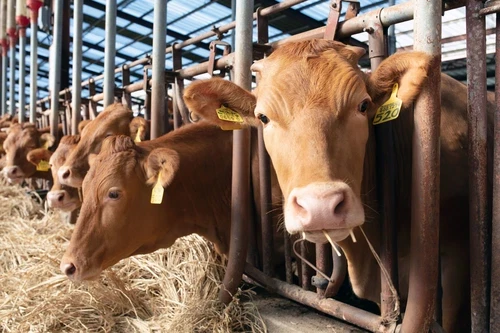
In the Yangdong region, about 100 kilometers east of Seoul, many cattle farms are scattered across a hilly landscape. Land is scarce, and most farmers keep around 30 animals. The largest farm, owned by Park Jae-deok, has about 420 cattle. Achieving perfect meat quality requires giving the animals a good life. The barns on his farm are open on all sides and immaculately clean—there is no smell of manure in the air. By law, each adult cow must have 9.9 square meters of space—something cows in many other countries can only dream of. The animals are cleaned and brushed daily, sometimes even scratched with a rake-like tool. On hot days, dozens of fans mounted on the roof supports provide cooling. At feeding time, Park Jae-deok even plays music: the cows pause briefly, then continue eating contentedly. Open grazing is rare in Korea due to limited land. Farmers also do not rely heavily on grass feed. »Our cows are fed twice a day with a special mix of corn and grains rich in protein to achieve excellent marbling—plus fresh hay«, says Park. »Every farmer has their own secret recipes they swear by.«
Today, all Hanwoo cattle in Korea are artificially inseminated using semen from top breeding bulls provided by a state institute. »Our production costs are higher than in Japan for Wagyu and more than twice as high as for Angus«, says Park. »To compete with cheaper imports, we focus on quality.« More than 80 percent of Korean beef now falls into grade 1 or higher. Hanwoo perfectly matches Korean taste preferences. »That’s why people here are willing to pay higher prices.« One kilogram of Hanwoo sirloin costs around 170 euros at the butcher. As prosperity rises, beef consumption has steadily increased, tripling in just 20 years to about 12 kilograms per person. Beef is eaten on important occasions such as weddings, births, or graduations. Premium Hanwoo steaks, elegantly packaged, are also popular holiday gifts.
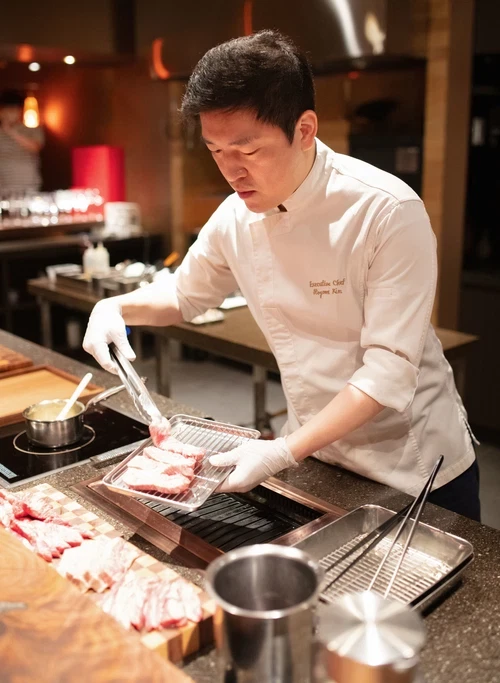
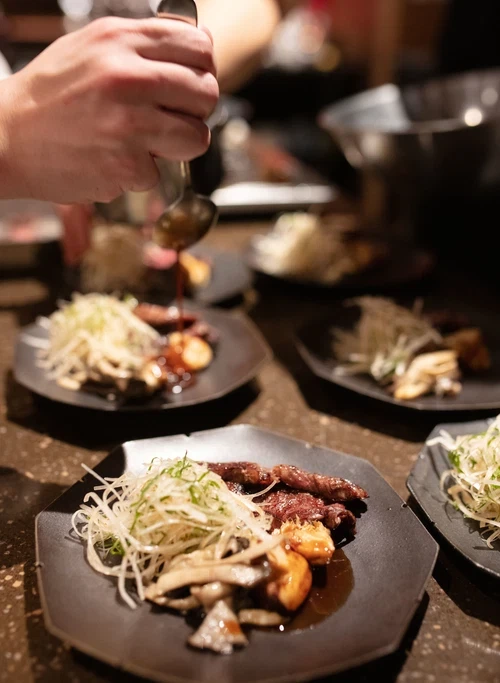
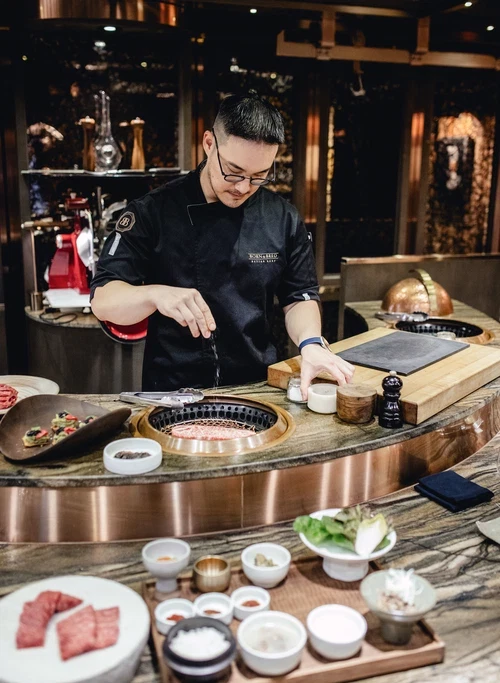
A walk through the streets of Seoul shows just how popular grilled meat is: barbecue restaurants are everywhere. They are easy to spot thanks to the table grills where guests cook their own meat. Above the grills hang ventilation hoods to capture the smoke. High-quality charcoal—preferably made from oak—is used for grilling. Some supermarkets even provide spaces where customers can grill the meat they have just purchased.
Today’s Hanwoo beef likely tastes worlds better than it did in the 1970s. »Thanks to the efforts of farmers, scientists, and the government, Hanwoo has completely transformed over the past 50 years«, says Seon-Tea Joo, professor at Gyeongsang University in Jinju. »Marbling, in particular, has improved significantly.«
He leads the Meat Science Laboratory, which develops different types of feed to achieve the ideal fat composition and fine marbling pattern in Hanwoo beef. His work is supported by a unique database containing detailed information on every animal. Seon-Tea Joo also studies the health effects of consuming Hanwoo. »We have every reason to believe that Hanwoo is healthier than Wagyu or Angus«, the scientist says. »This is due to its omega fatty acids and fat composition. Fewer carcinogenic substances are produced during grilling—because the fat melts and prevents the meat from burning.« The lab is currently working on breeding “super Hanwoo.” »Today, the animals weigh on average 700 to 800 kilograms—twice as much as 50 years ago. The new super Hanwoo reach up to 1,200 kilograms and cost between 10,000 and 15,000 euros per animal.«
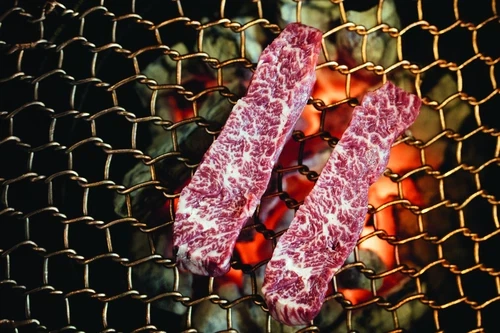
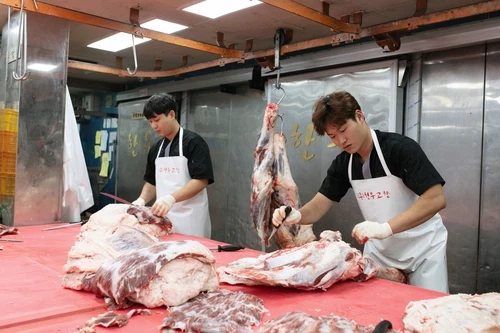
In the end, however, it all comes down to the butcher and the chef. Many of the best butcher shops are located in Seoul’s oldest meat market, Majang Market, where Hanwoo halves are delivered early in the morning and sold at auction.
The butchers are masters of their craft: they do not simply cut up the animal but carefully remove the bones first, then divide it into cuts. »In Korea, we like to say that a Hanwoo has 100 flavors«, explains Kim Ho yoon, one of Korea’s most renowned chefs.
While Europeans divide beef into around 30 cuts, in Korea there are up to 120: 73 from the body, 33 types of offal, and 14 from the head. »In Korea, every part is eaten«, says the chef. »Many Koreans are true beef gourmets—they have trained palates and can detect the finest differences in flavor.«
Kim Ho yoon is considered a leading authority in Korea. As chef at the restaurant »Hoshiwoobo«, he has elevated Hanwoo to new heights. Guests who order a thick steak should not be surprised: during grilling, the steaks are cut into smaller, bite-sized pieces using scissors. After all, Korea is a chopstick culture—but this does nothing to diminish the enjoyment.


