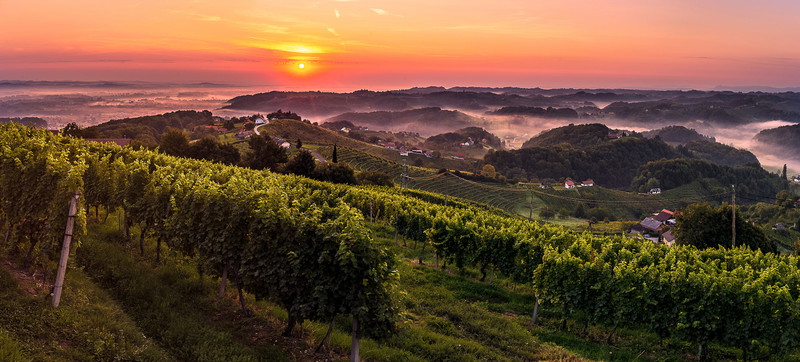
On the high, sunny slope of Čaven, above the village of Kamnje, called Grace, the Svetliks have planted a Rebula vineyard. And here, in the middle of the vineyards, Ivi and Edvard Svetlik are writing a new story of their lives. The small village of Kamnje lies in the Vipava Valley, a beautiful Slovenian wine-growing region just an hour and a half's drive from Venice. The sub-Mediterranean climate of the Vipava Valley has a positive effect on viticulture. The vineyard derives its charm and strength from its extremely sunny location as one of the highest vineyards in the Vipava Valley. The richness of the aromas of Rebula, an autochthonous grape variety that thrives particularly well both in the Vipava Valley and in Brda (Collio), proves that the location of the Rebula-Svetlik vineyard is ideal. The couple produces only 6,000 bottles from 8,000 vines.
The grape harvest is a day of celebration, when the Svetliks and their friends hand-pick the grapes they have tended all summer and into late fall. The grapes are crushed until the sugar turns into alcohol and the Rebula takes on its amber colour - just like the grapes themselves. It matures for two years in large oak barrels before being bottled unfiltered. Apart from the Rebula Maximilian I, a special bottling that matures in barrique barrels made from 354 old oak trees from the forest of King Louis XIV and is bottled in honour of Emperor Maximilian I. The Habsburg monarch had Rebula from the Vipava Valley delivered to his court as early as 1503. Rebula Svetlik is not only amber coloured, but also rich in aromas, minerals and nuances of taste. It is drunk like a red wine at a temperature of 15 degrees Celsius in a large glass so that it can develop its full richness.







 Route
Route