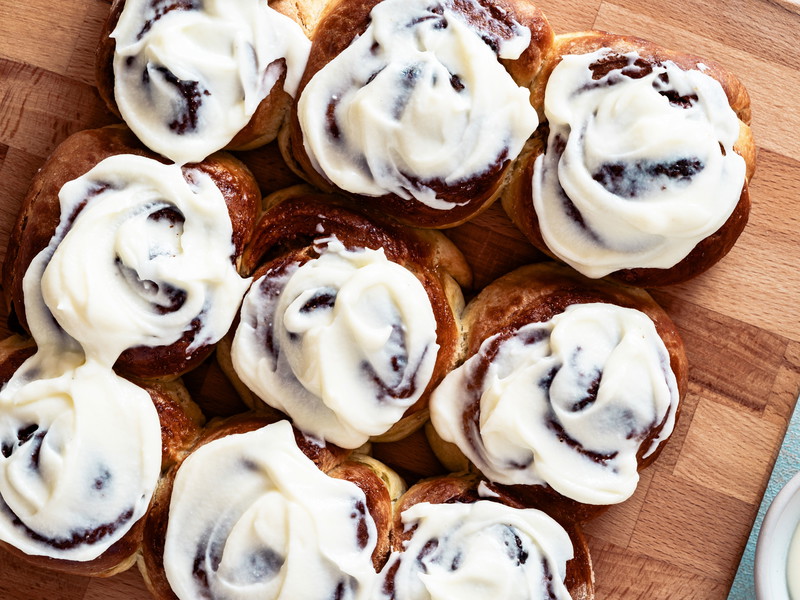
If any dish or pastry captures the taste of autumn, then one of them is definitely the cinnamon bun. In America, they are known as "Cinnamon Rolls", while in Nordic countries such as Sweden , but also occasionally in Germany, they are called Kanelbullar. Whether in the USA, Austria or Sweden, it is clear that this pastry has been riding the wave of success for some time now. It is no coincidence that bakeries such as Cinnamood have also found a way to attract numerous sweet tooths during the hot days with innovative cinnamon bun ice cream.
But what makes these fluffy yeast dough rolls so popular? Is it the cosy cinnamon note that is immediately noticeable when you bite into the oven-warm pastry, or is it the spicy-sweet aroma that is in the air when the snails are baked? Well, at first it could be because in principle less butter or sugar is used in the yeast dough than in the batter for cakes or tarts – so they don't seem too thick. What's more, the cinnamon buns are slightly crispy on the outside but soft and fluffy on the inside.
The snails can also be prepared in many different ways. The possibilities range from the simple classic version to variations with cream cheese icing, nuts or even fruit - one thing is certain: there is an option to suit every taste. Falstaff went in search of a few tricks that can make homemade cinnamon buns a success.
The dough sets the tone
As with all pastries, the base, i.e. the dough, is particularly important. In the case of the cinnamon buns, the dough should be kneaded for a long time before the first rising time so that the ingredients can combine well. It should then be allowed to rest sufficiently so that the gluten can develop properly. This makes the dough elastic and smooth. As cinnamon buns are made from yeast dough, it is particularly important that the yeast is fresh and that the correct rising temperature is ensured. This should be around 37 degrees Celsius.
The literal leading role
The dough should be rolled out neither too thick nor too thin. If the snails are too thick, there is a risk that the dough will not cook through; if they are too thin, the cinnamon rolls will be too flat and could burn quickly. A rule of thumb says that a thickness of around 0.5 cm is ideal. The filling also plays an important role. In the original version, this consists of a mixture of soft butter, sugar and cinnamon – this should be spread as evenly as possible over the dough so that it can be rolled easily.
Last but not least: the dough should be rolled carefully and with feeling so that it has enough room to rise during baking.
The perfect fullness
The traditional filling for cinnamon buns is made with a successful mixture of butter, cinnamon and sugar. It is best to use soft, but not melted butter, so that it can be spread evenly over the rolled-out dough. A mixture of brown and white sugar even provides a slight caramelisation and extra depth of flavour. It is important to use a generous amount of cinnamon in the filling to give the pastry its characteristic aroma. The filling can also be supplemented with a pinch of vanilla or nutmeg.
Brought into shape
To ensure that the cinnamon buns all have a uniform shape, use a piece of string to cut them. The reason for this is that, unlike the knife, the thread cuts through the dough nicely and does not crush it. A thin thread such as dental floss, for example, cuts clean and even snails. This way they all attain the same size and bake evenly.
To make them particularly juicy, the snails can be soaked in about 125ml of cream before baking. The snails soak up the juices in the oven and become wonderfully succulent.
The final steps
Once the cinnamon buns are in the oven, it's important to get the temperature right. The motto here is: don't bake too hot. The optimum temperature in the oven is around 180-190°C for around 20-25 minutes, or until golden brown. Excessively high temperatures quickly make them firm on the outside, but they still remain raw on the inside. So if you want particularly successful cinnamon buns, you should be patient.
There are also one or two things to consider with the icing: while the classic version - a mixture of milk, vanilla and powdered sugar – makes a delicious icing, an icing made from cream cheese, butter, powdered sugar and a little vanilla is more impressive and richer. With these tricks, nothing can go wrong - good luck!
Don't miss out!
Sign up now for our newsletter.