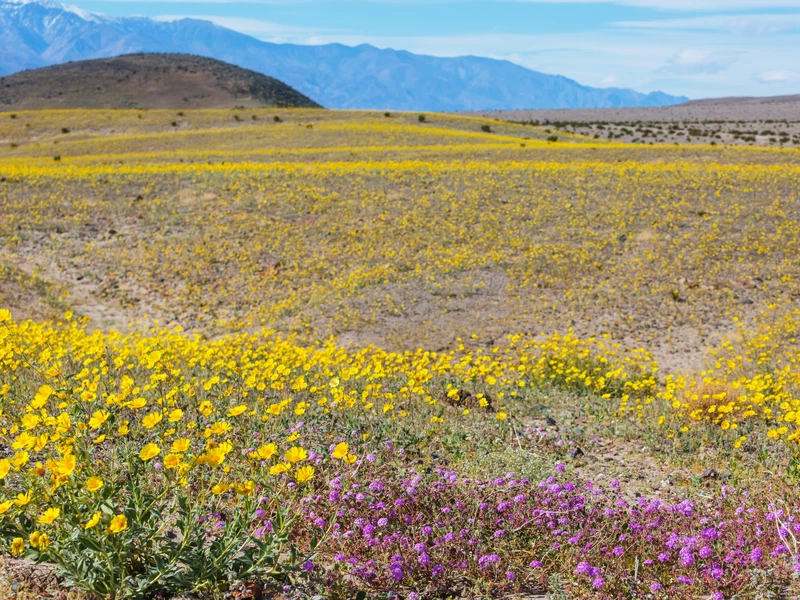
After an unusually wet winter, Death Valley National Park is revealing a side that is rarely seen: instead of dusty plains and salt-encrusted flats, vast swathes of the otherwise barren landscape are now blanketed in colorful blooms. Park rangers say it is the most impressive “super bloom” in nearly a decade.
The conditions were created by last winter: above-average rainfall across the western United States soaked the desert soils far more than usual.
Rain-rich winter brings the desert to life
The rare combination of moisture and mild temperatures allowed millions of seeds to germinate—many of which had lain dormant in the ground for decades.
Now desert sunflowers, brown-eyed primroses, and sand verbena are transforming the valley floor and surrounding slopes into glowing carpets of yellow, white, and pink. In the lower elevations, the spectacle is expected to continue well into March, while higher areas should follow between April and early summer—provided an early heat wave does not bring the natural event to an abrupt end.
Basins filled with rainwater
Water has even accumulated again in ancient lake basins dating back to the Ice Age. One of the current highlights is the refilled Lake Manly. Where salt crusts usually mark the lowest point of the valley, knee-deep water can now be found in places. Visitors wade through the mirror-like surface and experience a scene that feels more like an oasis than one of North America’s driest regions.
Large influx of visitors
However, the beauty also brings growing crowds. During previous bloom events, tens of thousands of people flocked to California’s desert landscapes, often in search of spectacular photo opportunities. In the process, fragile plants are easily trampled and the soil becomes compacted—damage that can affect the delicate ecosystem long after the flowers have disappeared.
Park authorities are therefore urging visitors to stay strictly on designated paths. Only if the desert remains undisturbed will it one day be able to burst into color again.