The Art of the Open Sandwich
Few culinary traditions capture the Danish spirit as gracefully as “smørrebrød”. Layered on dark rye and adorned with vibrant toppings, these open sandwiches are as much art as sustenance–a harmony of flavor, texture, and Nordic restraint. From the humble lunches of 19th-century workers to today’s refined cafés pairing each creation with beer and aquavit, smørrebrød remains a national treasure: generous, elegant, and unmistakably Danish.
Scrolling through a Danish town–perhaps along an old, cobbled street lined with half-timbered houses–you will, without doubt, sooner or later stop in front of a shop window filled with artfully made sandwiches of every kind: fresh, colorful, finely decorated and appetizing–smørrebrød, in short–one of the most quintessentially Danish phenomena imaginable.
The word itself comes from Danish smør (butter) + brød (bread), but the reality is far more refined than that. Smørrebrød are utterly elaborate–almost like savory pastries–and come in countless varieties.
Many countries, of course, have their own signature variants. In Europe alone, you’ll find Swedish sandvikare, Norwegian skiver, Finnish avoin voileipä, British sandwiches, Spanish bocadillos, Italian panini, French tartines, German Butterbrote, Austrian belegtes Brot, Polish kanapki, and Dutch boterhammen. Yet the Danish version is undoubtedly unique in being both substantial and elegant.
Danish Deli
The smørrebrød should not be confused with the world-famous Swedish smörgåsbord, which despite its name–literally meaning “sandwich table”–consists of a buffet with an abundance of small dishes, from gravlax and pickled herring to roast beef and smoked salmon. True, many of the same ingredients appear on smørrebrød, but not in the form of sandwiches.
Back to the walk. In the shop before you–the smørrebrødsforretning–you will face a large selection. To pick, you’ll need to fill out a smørrebrødsseddel—an order sheet where you tick your choices, and generally includes the following classics:
Leverpostej is one of Denmark’s most beloved smørrebrød, and features either warm or cold liver pâté on rye, often topped with crisp bacon and sautéed mushrooms. Roast beef, also on buttered rye bread, is another: The classic version comes topped with remoulade sauce, freshly grated horseradish, crispy onions, and pickled cucumber.
Dyrlægens natmad (lit. “the veterinarian’s midnight snack”) is a beautifully layered creation with–going from top to bottom–liver pâté, salt-cured beef, aspic, raw onion and pickled cucumber. Rullepølse (spiced meat roll) uses a similar combination, but the main ingredient is thinly sliced, spiced, boiled and pressed cold cuts, either of pork or lamb.
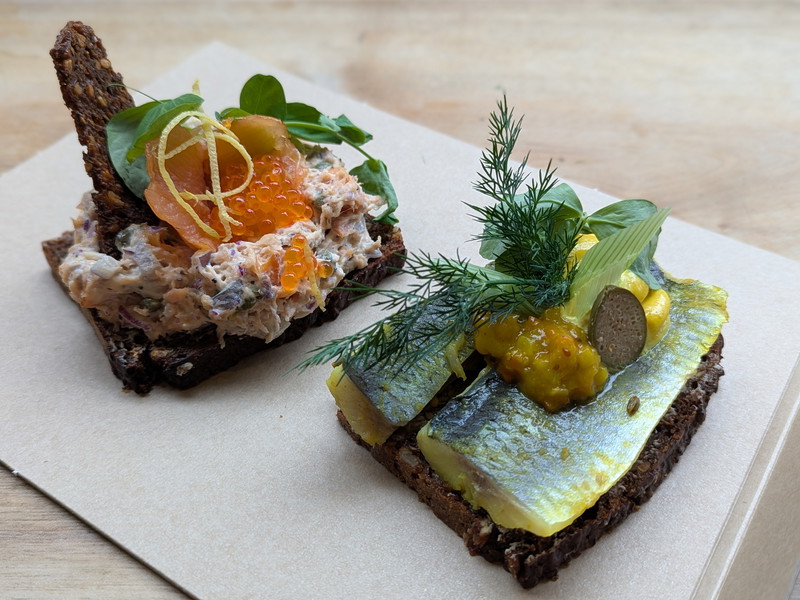
Fiskefilet consists of breaded and fried fish fillet (plaice is standard) on rye with remoulade sauce, lemon, lettuce and dill. Karrysild (curried herring) also enjoys enduring popularity: pickled herring in a mild curry sauce with apple, onion and sometimes capers, served on rye, often with a boiled egg.

As the name suggests, Tatar is finely chopped raw beef on rye, topped with a raw egg yolk, capers, chopped onion and horseradish, sometimes complemented with beetroot or small gherkins. And no selection would be complete without smoked or cured salmon on rye with dill and lemon, sometimes with prawns and a spoonful of horseradish cream or mustard dressing.
Two poetically named variations are Stjerneskud (shooting star), a festive smørrebrød featuring both steamed and fried fish fillets, hand-peeled prawns, mayonnaise, lemon and dill, often served on white bread instead of rye; and Sol over Gudhjem (“sun over Gudhjem”), which is smoked herring on rye, topped with a raw egg yolk (the sun) and finely chopped onion and chives–a classic from the island of Bornholm, it’s as pretty as it is iconic.
BIRTH OF AN ICON
Yet for all its luxe combinations, the origins of smørrebrød are quite humble. It first appeared in the early 19th century as a simple leftover lunch for workers and farmers: The coarse sourdough rye bread of the time was spread with a layer of butter and topped with the remains of yesterday’s dinner, then wrapped in paper or cloth and eaten cold during the working day. As industrialization spread through Denmark, the idea gradually spread to the growing number of factory workers needing a quick and filling meal. In time, inns began serving such popular sandwiches with beer or snaps.
Eventually, small shops and stalls appeared in Copenhagen, selling these sandwiches as smørrebrød. Often run by women, these snacks were inexpensive but held in high regard, beautifully decorated and delicious. Toward the end of the century, cafés moved smørrebrød in a more luxurious direction, with sifted bread, elaborate toppings and ever richer garnish.
And so, smørrebrød remain today – popular, yet refined. Still best enjoyed with beer and snaps, certain akvavits are said to pair especially well with certain smørrebrød: A classic roast beef with remoulade is said to unfold its true character with a cumin-spiced akvavit and a dark lager, as the beer’s roasted malt harmonizes with the meat and the sweetness of the remoulade. The golden curried herring, on the other hand, comes to life with a dill-spiced akvavit and a light pilsner, as the clean bitterness of the latter refreshes the palate between the herring’s sweet-and-tangy tones. And mild smoked salmon with horse radish is best served with a fennel- and anise-spiced akvavit and some wheat beer for a gentle interplay of herbs and fruit.
So, step inside the shop and take your pick! And don’t forget, “En bajer og en lille!”–beer and snaps!